
What is shipment consolidation FBA: UK seller guide
- primenest2026
- May 22
- 9 min read

Many UK Amazon sellers assume shipment consolidation is only worth considering once you’re moving large volumes. That misconception costs them money from day one. Understanding what is shipment consolidation FBA means recognising it as a fundamental logistics decision, not an advanced one. Whether you’re sourcing from multiple suppliers in China or managing stock across domestic warehouses, how you group and route your inbound shipments directly affects your margins, your compliance standing with Amazon, and how quickly your stock goes live. This guide cuts through the complexity and gives you a clear, practical picture of how consolidation works and when to use it.
Table of Contents
Key takeaways
Point | Details |
Consolidation reduces freight costs | Combining shipments can cut inbound freight expenses by 20–50% by maximising load efficiency. |
Create your shipping plan first | Generating your Amazon shipping plan before consolidation prevents costly re-labelling and shipment mismatches. |
Labelling accuracy is non-negotiable | Every carton needs a unique Box ID label from Seller Central; reusing or photocopying labels causes rejection. |
Prep centres simplify the process | A qualified UK FBA prep centre handles receiving, labelling, and compliance checks before your shipment moves. |
Consolidation suits high-volume sellers | The cost-benefit is strongest when you have multiple SKUs, multiple suppliers, or regular restocking cycles. |
What is shipment consolidation in FBA logistics?
At its core, shipment consolidation means combining multiple smaller consignments into a single, larger shipment before sending them to Amazon’s fulfilment centres. Instead of dispatching ten separate small boxes from different suppliers on different days, you route everything to a central point, prepare it to Amazon’s standards, and send it as one organised inbound shipment.
Within FBA logistics, there are two dominant consolidation models you’ll encounter. LCL (Less than Container Load) applies to sea freight, where your goods share a container with other shippers’ cargo. You pay only for the cubic space your shipment occupies. LTL (Less than Truckload) applies to road freight, where your pallets share a truck with other loads heading in the same direction. Both models allow you to access bulk freight rates without needing to fill an entire container or vehicle yourself.
The parties involved in a typical consolidation flow include:
You, the seller coordinating purchase orders and shipment timelines
Your suppliers dispatching goods to a consolidation point
A prep centre or 3PL receiving goods, completing FBA prep, and building the shipment
A freight forwarder arranging transportation and customs clearance
Amazon’s fulfilment centres receiving the compliant inbound shipment
Understanding this chain matters because each party has specific responsibilities, and a gap at any stage creates compliance issues or delays.
Benefits and challenges of consolidation for UK sellers
The financial case for consolidation is clear. Freight costs drop by 20–50% when you maximise load efficiency and split transportation expenses across multiple shipment lines. For UK sellers sourcing from Asia, where sea freight is the primary option, this saving is substantial over a year of regular shipments.

Beyond cost, consolidation reduces administrative complexity. Instead of tracking ten separate shipments through customs, you manage one. Carrier invoices, customs declarations, and delivery notifications all collapse into a single workflow. The structural efficiency gains come from economies of scale, reduced invoice fragmentation, and lower scheduling complexity across your operations.
That said, consolidation does carry genuine risks if you go in underprepared:
Prep compliance gaps: Since Amazon discontinued its own FBA prep services in the US in early 2026, sellers are fully responsible for arriving units being correctly prepped and labelled. Errors mean fees of £0.40 to £2.00 or more per unit, or outright rejection.
Consolidation delays: Waiting for the last supplier to deliver before your forwarder can book a container can push your despatch window back significantly.
Re-labelling costs: If FNSKU labels are missing or incorrect when goods arrive at the prep centre, relabelling adds time and cost before anything can be consolidated.
Mixing incompatible SKUs: Grouping products with different prep requirements without flagging them to your prep centre causes confusion and processing errors.
Pro Tip: Build a two-week buffer into your consolidation timeline to absorb supplier delays without missing your freight booking window.
The shipment consolidation process step by step
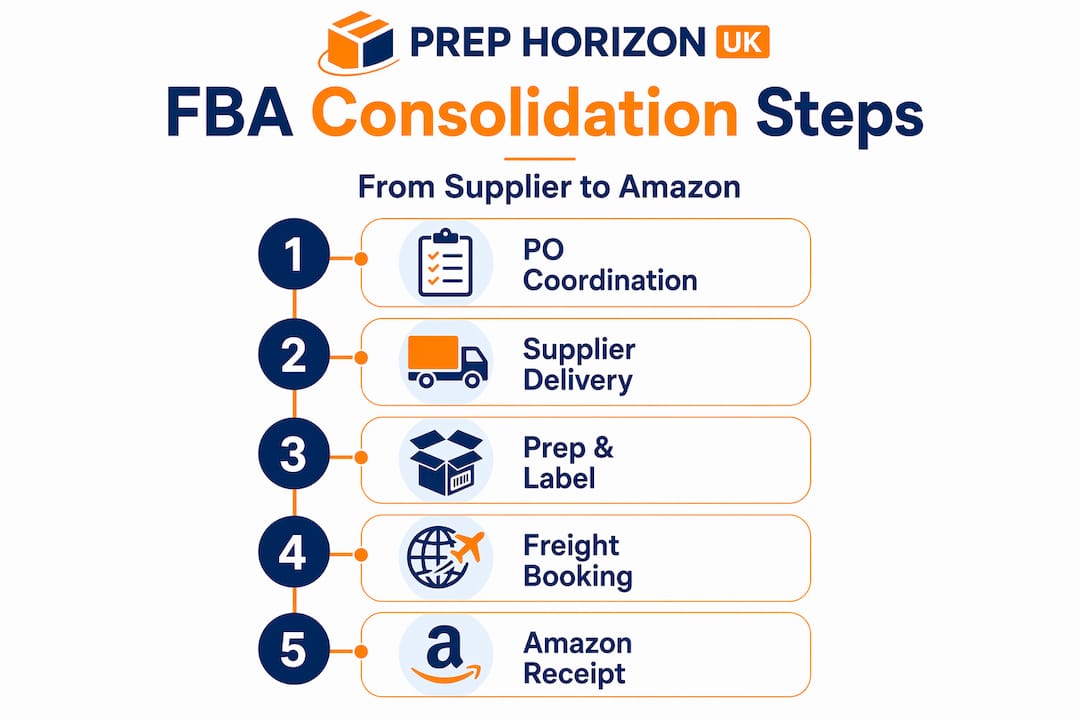
For a UK seller using a prep centre or 3PL, the consolidation process follows a logical sequence. Here’s how a typical flow looks:
Raise your purchase orders and notify your prep centre. Share expected arrival dates, quantities, and SKU details so the warehouse can plan receiving slots and labour.
Suppliers despatch goods to the prep centre. The prep centre receives and inspects each delivery against your PO, flagging discrepancies before they become a problem further down the line.
FBA prep and labelling take place. This covers FNSKU labelling, poly-bagging, bubble wrap, bundling, and any category-specific requirements. Given the 2026 FBA prep compliance rules, every unit must arrive at Amazon’s fulfilment centre fully prepared with no exceptions.
Create your Amazon shipping plan in Seller Central. This is a critical step that many sellers get wrong by leaving it too late. Creating the shipping plan first generates the correct FNSKU assignments and destination FC information before cartons are packed and sealed.
Apply Box ID labels to cartons. Each carton needs a unique Box ID label generated directly from your Seller Central shipment workflow. Photocopied labels and reused labels are a leading cause of shipment rejection at the fulfilment centre.
Group and palletise according to Amazon and UK pallet standards. UK pallets for Amazon FBA must be 1,200mm x 1,000mm, with a maximum height of 1.8m and maximum weight of 1,000kg. Your prep centre should handle this, but always verify.
Book freight and hand over to your forwarder. Your freight forwarder arranges collection, consolidation at the port or hub if LCL, and books the sailing or truck slot.
Track the shipment through to delivery. A typical LCL consolidated shipment from factory pickup to Amazon FC delivery runs 28 to 35 days, including origin consolidation, transit, customs clearance, and final delivery.
Stage | Who is responsible | Key risk |
PO coordination | Seller | Supplier delays holding up the full consolidation |
Receiving and inspection | Prep centre | Undetected damaged or incorrect stock |
FBA prep and labelling | Prep centre | Non-compliant units attracting fees or rejection |
Shipping plan creation | Seller | Wrong FCs assigned or labelling mismatches |
Freight and customs | Freight forwarder | Delays or documentation errors |
FC delivery | Amazon | Receiving discrepancies |
Pro Tip: Always create your Amazon shipping plan and download the Box ID labels before sealing any carton. Cartons sealed without correct labels will need to be reopened at the prep centre, adding cost and delay.
Consolidation vs direct shipping and other FBA shipment methods
Choosing between consolidation and direct shipping depends on your order size, product range, and how often you restock. Understanding both options helps you make the right call for each shipment cycle.
Direct shipping means each supplier sends goods separately and directly to Amazon’s fulfilment centre or to you. It works for sellers with a single SKU and a single supplier, or for urgent top-up shipments where speed matters more than cost. The downside is higher per-unit freight costs and more administrative work across multiple shipments.
Here is how the two approaches compare across the factors that matter most to UK FBA sellers:
Factor | Consolidation | Direct shipping |
Freight cost per unit | Lower, especially for sea freight | Higher for small or frequent shipments |
Admin complexity | One shipment to manage | Multiple shipments and invoices to track |
Lead time | Longer due to consolidation window | Shorter for urgent stock needs |
Minimum viable volume | Multiple SKUs or suppliers | Single SKU, small quantities |
Compliance control | Centralised at prep centre | Varies by supplier |
Best for | Regular restocking, multi-SKU sellers | Urgent restocks, single-supplier operations |
The sweet spot for consolidation is when you have at least two suppliers contributing to the same shipment cycle, or when your total carton count justifies the wait for a full consolidation window. For a one-off urgent shipment of ten cartons, direct air freight may still win on total delivered cost. For a planned monthly restock of mixed SKUs, consolidation through a prep centre is almost always the better choice.
FBA shipment optimisation tips for UK sellers
Getting consolidation right consistently means building the right habits before your freight ever moves. These FBA shipment optimisation tips are grounded in what actually causes problems, not theoretical checklists.
Start your Amazon shipping plan at the point of ordering, not despatch. Shipping without a plan risks expensive re-labelling or re-routing. The plan determines which FC receives your stock, and that affects everything downstream.
Use unique FNSKU labels per SKU per unit. Mixing unlabelled or incorrectly labelled units into a consolidated shipment creates receiving errors that can suppress your listing or lock up inventory.
Choose a prep centre with proven FBA consolidation experience. Not all 3PLs understand Amazon’s inbound requirements. Your prep partner should know FBA prep requirements in detail, from poly-bagging rules to carton weight limits.
Verify carton weights and dimensions before sealing. Amazon has strict limits on carton weight, typically 23kg for standard shipments. Overweight cartons get refused or generate penalty fees.
Set a consolidation window and stick to it. Automating rate decisions and using time-bound consolidation cycles improves efficiency and prevents the common trap of waiting indefinitely for one late supplier.
Never mix incompatible SKUs without clear documentation. If products have different prep requirements, label them clearly and communicate this to your prep centre before goods arrive.
Pro Tip: Ask your prep centre for a carton-level packing report before they palletise. This gives you the exact content of each box, which you’ll need if Amazon ever raises a receiving discrepancy.
Sellers who treat labelling as an afterthought consistently face the highest rates of shipment rejection and inventory delays. Understanding what labels are required for Amazon FBA before your first consolidated shipment moves will save you significant time and money.
My take on why UK sellers underestimate consolidation
I’ve seen many UK sellers treat consolidation as a logistics detail they’ll figure out later. In my experience, that attitude is where the expensive lessons happen.
The sellers who get the most from consolidation are not necessarily the biggest. They’re the most organised. They create their shipping plans early, they communicate carton details to their prep centres clearly, and they don’t cut corners on labelling. What I’ve found is that the hidden costs of ignoring best practices are not just financial. Delayed stock means lost sales rank, stockouts during peak periods, and the stress of managing Amazon support cases about missing inventory.
What actually works is building a close working relationship with a prep centre that understands your product range and your restocking rhythm. When your prep partner knows what’s coming and when, they can flag issues before they become problems. That relationship is worth more than any freight rate saving in isolation.
My honest view: consolidation is less about cutting costs and more about running a tighter, more predictable operation. The cost savings are real, but the real advantage is the control you gain over your inbound supply chain.
— Prep
How Prephorizonuk supports your consolidation process
If you’re ready to make shipment consolidation work properly for your FBA business, Prephorizonuk handles every stage that typically trips sellers up.

From receiving your supplier deliveries and inspecting stock on arrival, to applying FNSKU labels, completing full FBA prep to 2026 compliance standards, and building palletised shipments ready for your freight forwarder, Prephorizonuk manages it all under one roof. The team stays current with Amazon’s inbound requirements so you don’t have to. Whether you’re sending mixed SKUs from multiple suppliers or running a single-product restock, the process is handled accurately and quickly. Explore the FBA prep services and check affordable pricing plans designed specifically for UK Amazon sellers who want a reliable prep partner they can count on.
FAQ
What is shipment consolidation for Amazon FBA?
Shipment consolidation for FBA means combining multiple smaller consignments into one larger inbound shipment before sending stock to Amazon’s fulfilment centres, reducing freight costs and administrative complexity in the process.
How much can consolidation reduce my freight costs?
Consolidation can reduce inbound freight costs by 20–50% by maximising load efficiency and splitting transportation expenses across multiple shipment lines, making it particularly effective for UK sellers shipping from Asia.
Do I need to create my Amazon shipping plan before consolidating?
Yes. Creating your shipping plan first generates the correct FNSKU assignments and destination FC information, and allows you to print accurate Box ID labels before cartons are sealed.
How long does a consolidated FBA shipment take from China to the UK?
A typical LCL consolidated shipment takes 28 to 35 days from factory pickup to Amazon fulfilment centre delivery, covering consolidation, transit, customs clearance, and final delivery.
Can I consolidate shipments with different prep requirements?
Yes, but you must clearly document each SKU’s prep requirements and communicate them to your prep centre before goods arrive. Mixing undeclared incompatible products in a consolidated shipment leads to processing errors and potential compliance failures.
Recommended

Comments