
UK FBA seller startup guide for 2026

Amazon FBA offers UK entrepreneurs a genuine route to financial independence, but the path from idea to profitable business is cluttered with compliance traps, fee structures, and logistics decisions that catch most beginners off guard. This UK FBA seller startup guide cuts through that complexity. Whether you are weighing up VAT registration, choosing your first products, or trying to understand what Amazon actually charges you, the answers are here. Initial capital for a UK FBA startup can be as low as £200 for retail arbitrage or up to £3,500 for private label, so the barrier to entry is lower than most people think.
Table of Contents
Key takeaways
Point | Details |
VAT registration is not optional | Non-UK sellers must register for VAT the moment goods are stored in a UK warehouse, before any sales begin. |
Professional plan is worth every penny | The £30/month Professional selling plan unlocks the Buy Box and bulk listing tools essential for FBA growth. |
Fees consume 30 to 50% of revenue | Factor referral fees, fulfilment fees, and storage costs into your pricing before you list a single product. |
Reorder points prevent stockouts | Use sales velocity and lead times together to calculate when to reorder, not gut instinct. |
Prep compliance protects your account | Incorrect labelling and packaging can get shipments rejected or your account suspended. |
Legal and financial setup for UK FBA sellers
Before you list a single product, you need the right legal and financial foundations in place. Get this wrong and you risk frozen funds, HMRC penalties, or a suspended Amazon account.
Sole trader vs limited company
Most beginners start as sole traders because it is simpler and cheaper to set up. You register with HMRC for Self Assessment, keep your own records, and pay income tax on profits. A limited company offers more credibility with suppliers, limits your personal liability, and can be more tax-efficient once profits exceed roughly £30,000 per year. There is no universal right answer. Start with what suits your current risk appetite and upgrade later if the business justifies it.
You will also need a dedicated business bank account. Mixing personal and business finances is a false economy that creates accounting chaos. Several UK challenger banks such as Monzo Business or Starling Business offer free accounts with instant notifications, which suits lean startups well.
UK VAT and FBA sellers
This is where many new sellers come unstuck. UK-established businesses must register for VAT once their rolling 12-month turnover exceeds £90,000. However, if you are a non-UK seller sending stock to Amazon’s UK fulfilment centres, you must register immediately from the moment goods land on UK soil, regardless of sales volume. Amazon shares data directly with HMRC, so there is no hiding.
VAT returns are filed quarterly and must reconcile your total turnover, the VAT collected, and any refunds. Quarterly VAT returns require precise records, and errors attract penalties that can wipe out months of profit.
Pro Tip: If you are a non-UK seller, appoint a UK-based VAT agent before shipping your first unit. The cost is modest compared to the risk of a frozen seller account or a surprise HMRC bill.
Register your business with Companies House (limited company) or HMRC (sole trader)
Open a dedicated business bank account before applying for your Amazon seller account
Apply for a VAT number via HMRC’s online portal, allowing four to six weeks for processing
Store your VAT certificate, business registration documents, and proof of address securely
Setting up your Amazon Seller Central account
Getting your account set up correctly from day one saves weeks of delays and prevents verification headaches down the line.
Individual vs Professional selling plan
The Individual plan charges £0.75 per item sold and excludes critical features like bulk listing, advertising, and access to restricted categories. The Professional plan costs £30 per month and removes those limitations entirely. For anyone serious about starting an FBA business in the UK, the Professional plan is not a luxury. It is the minimum viable setup.
Step-by-step account registration
Go to sellercentral.amazon.co.uk and click “Register now”
Choose the Professional selling plan during sign-up
Provide your legal business name, registered address, and company registration number if applicable
Upload a valid government-issued photo ID and a bank statement or utility bill dated within the last 90 days
Enter your bank account details for receiving payments and a valid credit card for fee collection
Complete Amazon’s identity verification video call, which typically takes 10 to 20 minutes
Set your VAT number in the Tax Settings section of Seller Central once registration is approved
Configure your deposit schedule and select your product categories
Pro Tip: Use your registered business address consistently across all documents. Any mismatch between your ID, bank statement, and Amazon application is the single most common cause of account verification delays.
Common pitfalls to avoid include using a personal bank account, submitting expired ID, or registering with a residential address when your company is registered elsewhere. Amazon’s verification team is thorough, and inconsistencies trigger manual reviews that can take two weeks or more.
Product sourcing, FBA prep, and shipping
Once your account is live, the focus shifts to getting the right products into the right fulfilment centres in the right condition.

Sourcing methods compared
Method | Startup cost | Complexity | Profit potential |
Retail arbitrage | £200 to £500 | Low | Moderate |
Wholesale | £1,000 to £2,500 | Medium | Medium to high |
Private label | £1,500 to £3,500 | High | High |
Retail arbitrage suits beginners because the capital requirements are low and feedback loops are fast. You buy discounted products from UK retailers and resell them at a profit on Amazon. Private label requires more upfront investment but builds a brand you own entirely.
FBA prep requirements
Amazon’s packaging and labelling standards are strict. Every unit needs an FNSKU barcode, suffocation warning labels on polybag items, and appropriate protective packaging. One rejected shipment costs you time and money and can delay your launch by weeks. You can find detailed guidance in this UK packaging compliance guide to avoid the most common errors.
Each unit must carry an FNSKU label, not a manufacturer barcode, unless you are enrolled in Amazon’s barcode exemption programme
Polybags must be a minimum of 5 centimetres wide and display a suffocation warning in a font size legible at arm’s length
Fragile items require bubble wrap or foam with a “Fragile” label visible on the outside of the box
Shipment boxes must not exceed 23 kg in weight and must include a box content label on two adjacent sides
Pro Tip: Partnering with a trusted UK prep centre lets you send stock directly from your supplier, saving you the time and physical space of handling prep yourself. It also reduces the risk of rejected shipments caused by small labelling errors. Learn more about FBA prep for new sellers to understand what the process involves before you commit.
For shipping to fulfilment centres, small parcel carriers such as UPS and DHL work well for low-volume shipments. Pallet freight becomes cost-effective above roughly 200 units. Review the full process in this step-by-step shipping guide before booking your first inbound shipment.
Inventory management and cash flow planning
Running out of stock on Amazon is expensive. Your ranking drops, your Buy Box eligibility suffers, and recovering lost momentum takes longer than most sellers expect.
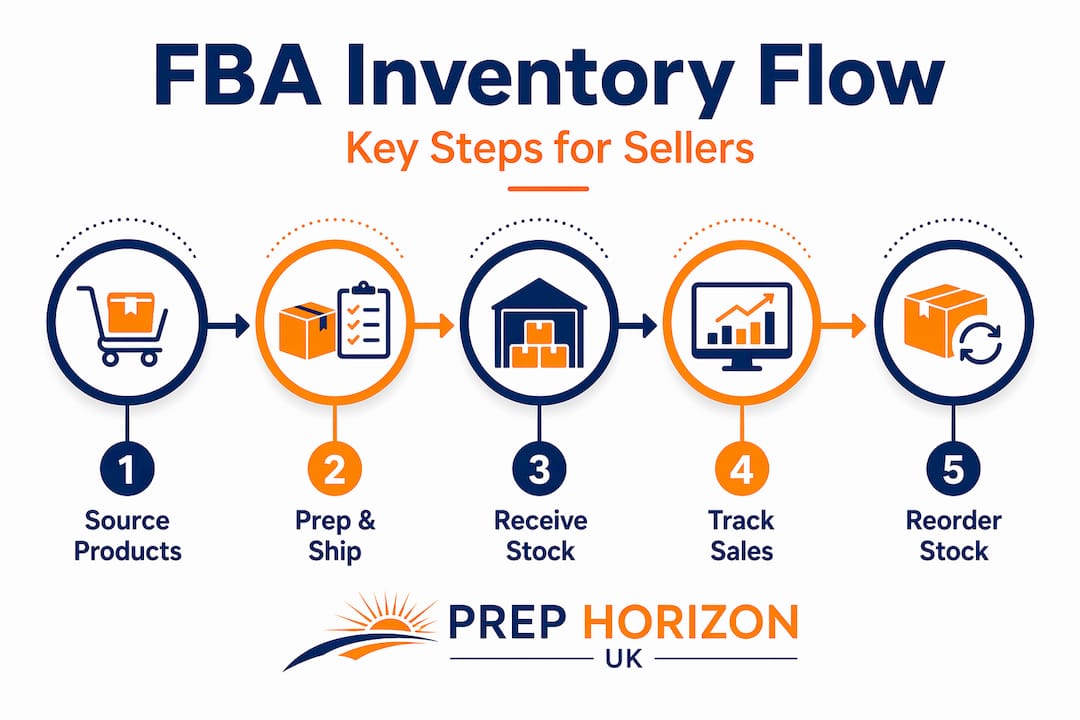
Calculating your reorder point
The formula is straightforward: Reorder Point = (daily sales velocity × total lead time) + safety stock. Total lead time includes production time, shipping from supplier, customs clearance if importing, and Amazon’s check-in time at the fulfilment centre. That final step alone can take three to seven days and is often forgotten.
For a product selling 10 units per day with a 30-day total lead time and a 5-day safety buffer, your reorder point is 350 units. Order when you hit 350, not when you hit zero.
Managing purchase orders through stages
Forecast: Review the last 30, 60, and 90 days of sales data and adjust for seasonality
Decision date: Set a hard calendar date by which you must place the order to avoid stockout
Order placed: Confirm with the supplier and log the expected delivery window
In transit: Track the shipment and flag any delays to your decision timeline
Checked in: Confirm Amazon has received and processed units before closing the PO
The sales velocity and lead times tracking approach is especially important for sellers managing 20 or more SKUs, where guesswork becomes genuinely dangerous.
Pro Tip: Build your inventory schedule around known disruptions. Chinese New Year typically shuts Chinese factories for two to four weeks in January or February. Q4 brings Amazon’s highest storage fees and longest check-in times. Plan six to eight weeks ahead of both.
Cash flow management sits alongside inventory planning. Many sellers exhaust working capital by reordering too aggressively, then cannot fund advertising during peak periods. A simple rule: keep at least one full reorder cycle worth of capital available at all times. More detailed frameworks for managing FBA inventory are worth reviewing before you scale beyond your first product.
Understanding Amazon FBA fees and profitability
Amazon FBA fees typically consume 30 to 50% of your selling price. Understanding where that money goes before you price your product is not optional.
Fee breakdown for UK sellers
Monthly subscription: £30 for the Professional selling plan
Referral fees: Between 7% and 45% depending on category, with most consumer goods sitting at 8 to 15%
Fulfilment fees: From £1.83 per unit for small, lightweight items up to £12 or more for oversized products
Storage fees: Charged monthly per cubic foot, with rates roughly doubling during Q4 (October to December)
Optional costs: Advertising (pay-per-click), promotional discounts, and returns processing fees
Use Amazon’s FBA Revenue Calculator before committing to any product. Enter your expected selling price, product dimensions, and category, and the tool returns an estimated profit figure. A product that looks promising at £19.99 can turn negative once you account for referral fees, fulfilment, storage, and VAT.
One mistake beginners make consistently: pricing without VAT in the calculation. If you are VAT-registered, you collect VAT on behalf of HMRC but do not keep it. Your actual revenue is the sale price minus the VAT element. Ignoring this inflates your apparent margins and leads to nasty surprises at the end of the quarter.
What I’ve learned from watching sellers launch
In my experience working alongside new FBA sellers, the ones who struggle most are not the ones who picked a bad product. They are the ones who underestimated how much the operational side of the business demands from day one.
VAT compliance catches people off guard more than anything else. I have seen sellers several months into trading who had no idea they were already in breach of HMRC’s registration requirements because they assumed the £90,000 threshold applied to them as overseas sellers. It does not. Storing goods in the UK triggers registration regardless of turnover, and HMRC uses Amazon data to identify non-compliant sellers. The consequences, including frozen funds and suspended accounts, are disproportionately severe for a business still finding its feet.
What I find most useful to tell new sellers is this: treat FBA like a real business from the very first order. That means a proper bank account, a spreadsheet tracking every cost, a VAT agent if you are not UK-based, and a reorder schedule that does not rely on memory. The sellers who treat it as a side project rarely scale past their second product.
The other shift worth making early is accepting that prep and logistics are not peripheral tasks. They are the engine. A well-prepped, correctly labelled shipment that arrives on time at a fulfilment centre is worth more to your account health than any amount of keyword research.
— Prep
How Prephorizonuk helps new FBA sellers get it right

Starting an FBA business in the UK carries enough complexity without having to master warehouse logistics at the same time. Prephorizonuk is a UK-based FBA prep centre built specifically for sellers who want their inventory handled correctly without the overhead of managing it themselves. The service covers receiving, inspection, FNSKU labelling, polybag wrapping, bundling, and full shipment creation to Amazon’s requirements.
For new sellers in particular, outsourcing prep removes one of the most common causes of rejected shipments and account warnings. Prephorizonuk communicates clearly at every stage, with fast turnaround times that keep your restock schedule on track. If you want a reliable partner while you focus on growing your product range, explore prep pricing and services to find an option suited to where you are in your launch journey. You can also review cost-saving prep strategies to get a sense of where the smart money goes when margins are tight early on.
FAQ
How much money do I need to start Amazon FBA in the UK?
You can begin with retail arbitrage for as little as £200 to £500, while private label models typically require £1,500 to £3,500 upfront. Budget additional funds for Amazon’s £30 monthly fee and initial advertising spend.
Do UK sellers need to register for VAT before making sales?
UK-based sellers must register once turnover exceeds £90,000, but non-UK sellers must register immediately upon storing goods in a UK fulfilment centre, regardless of sales volume.
What is the difference between the Individual and Professional selling plans?
The Individual plan charges £0.75 per sale and lacks bulk listing, advertising, and Buy Box eligibility. The Professional plan at £30/month is the standard choice for anyone running FBA seriously.
How do I avoid running out of stock on Amazon?
Calculate your reorder point using this formula: daily sales velocity multiplied by total lead time, plus a safety stock buffer. Review your inventory weekly and set fixed decision dates tied to your supplier lead times.
What happens if my FBA shipment fails Amazon’s prep requirements?
Amazon will reject the shipment or charge you for remedial work at the fulfilment centre. Repeated non-compliance can result in account warnings or restrictions. Using a compliant UK prep centre before shipping removes this risk entirely.
Recommended
Comments