
What FBA seller experience means and how to improve it

Many Amazon FBA sellers assume that once their inventory is packed and dispatched to a fulfilment centre, the hard work is largely done. That assumption is costly. The reality is that your seller experience on Amazon is shaped by a web of performance metrics, policy changes, prep quality, and operational decisions that interact every single day. Understanding what FBA seller experience actually means, and knowing how to actively improve it, is the difference between an account that thrives and one that quietly deteriorates.
Table of Contents
Key Takeaways
Point | Details |
Metrics shape experience | Amazon’s performance metrics determine your FBA privileges and overall seller standing. |
Policies can squeeze margins | Changing Amazon policies and fees directly affect your profitability and require constant adjustment. |
Prep services add value | Professional FBA prep services help UK sellers reduce operational risk and streamline compliance. |
Mindset matters | Lasting FBA success depends on adaptability and partnership, not just following checklists. |
Defining FBA seller experience: More than just logistics
The phrase “seller experience” gets used loosely, but it carries real weight on the Amazon platform. At its core, FBA seller experience refers to the full range of operational, metric-driven, and emotional dimensions that a seller navigates while using Fulfilment by Amazon. It is not simply about getting products into a warehouse.
On the operational side, your experience includes creating shipments, prepping products to Amazon’s standards, managing stock levels, and handling returns. On the metric side, it means maintaining the performance indicators that Amazon monitors continuously. And on the emotional side, it involves coping with the unpredictability of policy shifts, fee increases, and the ever-present pressure to stay compliant.
The metrics dimension is particularly important because it directly governs what you can do on the platform. As FBA performance metrics show, FBA operations expose sellers to ongoing performance measurement, meaning that “seller experience” includes maintaining metrics that affect seller standing and privileges. The key indicators include:
Order Defect Rate (ODR): The percentage of orders that receive a defect, such as a negative review, an A-to-Z claim, or a chargeback.
Perfect Order Percentage (POP): The proportion of orders fulfilled without any issue whatsoever.
Inventory Performance Index (IPI): A score that reflects how efficiently you manage your FBA inventory, including sell-through rates and stranded inventory.
Customer feedback score: Your overall star rating from verified buyers, weighted by recent performance.
Return dissatisfaction rate: The percentage of return requests that are handled poorly or disputed by the seller.
For UK sellers, understanding seller services for UK FBA is a helpful starting point for mapping out all the touchpoints that contribute to this experience.
“The relentless pressure of Amazon’s performance metrics means that even a handful of defective orders in a single week can trigger warnings that take months to recover from. Sellers who underestimate this live in a permanent state of firefighting.”
That emotional weight is real. Many sellers describe a sense of limited control, particularly when metrics shift because of factors outside their direct management, such as carrier delays or customer misuse. This is why building a resilient operation matters as much as knowing the numbers.
Key FBA performance metrics and their impact
To understand what makes or breaks your FBA seller experience, let’s dig deeper into the specific metrics that underpin your status. Amazon does not treat all metrics equally, and each one carries different consequences when it dips below acceptable thresholds.
The following table summarises the core FBA performance metrics, their standard benchmarks, and what happens when they fall short.
Metric | Target threshold | Consequence of falling short |
Order Defect Rate (ODR) | Below 1% | Account suspension risk |
Perfect Order Percentage (POP) | Above 95% | Reduced Buy Box eligibility |
Inventory Performance Index (IPI) | Above 400 | Loss of unlimited FBA storage |
Customer feedback score | Above 4.0 stars | Reduced visibility and trust |
Return dissatisfaction rate | Below 10% | Performance warning issued |
As documented by FBA performance components, the commonly cited set of measures includes Order Defect Rate, Perfect Order Percentage, customer feedback, return dissatisfaction, and Inventory Performance Index. Each one tells Amazon a different story about how reliably you serve customers.
Here is how a typical metric decline plays out in practice:
A shipment arrives at the fulfilment centre with incorrectly labelled units. Amazon cannot process them efficiently, leading to delays in stock availability.
Customers order items shown as in stock but face longer delivery windows. This damages your Perfect Order Percentage.
Some customers leave negative feedback or raise A-to-Z claims. Your ODR begins to creep upward.
Amazon sends a performance warning. You now have a limited window to respond with a credible action plan.
If the issue persists, selling privileges are suspended. Revenue stops completely while the appeal process unfolds.
This sequence happens more often than sellers expect, and it often traces back to prep errors that were entirely preventable. Understanding FBA prep requirements in detail is one of the most practical steps you can take to protect your metrics upstream.
It is also worth noting that FBA shipping compliance plays a direct role in maintaining IPI scores. Shipments that arrive incorrectly packed, labelled, or documented consume additional processing time at Amazon’s centres, which can delay inventory availability and suppress your sell-through rate.
Key fact: An IPI score below 400 can result in Amazon restricting the amount of inventory you can send to their fulfilment centres. For high-volume sellers heading into peak periods like Q4, this restriction can be devastating for revenue.
How Amazon policies and fee changes affect seller experience
Now that we have outlined the metrics, it is vital to recognise how outside factors like policy and fee shifts can shake up the FBA seller experience. Amazon regularly updates its fee structures, prep requirements, and compliance rules, and these changes can materially affect your margins and operational planning.
Common types of changes that directly affect UK FBA sellers include:
Fulfilment fee increases: Amazon periodically raises the per-unit cost of fulfilment based on size and weight categories, squeezing margins on lower-priced products.
Storage fee adjustments: Long-term storage fees and peak-period surcharges can erode profitability for sellers holding slow-moving stock.
New prep and packaging requirements: Requirements for poly bagging, bubble wrap, and dunnage are updated regularly, meaning non-compliant shipments face refusal or additional charges.
Changes to reimbursement policies: Updates to how Amazon reimburses lost or damaged inventory can reduce what sellers recover when issues arise.
Advertising cost inflation: As more sellers compete for the same keywords, sponsored ad costs rise, putting pressure on overall margins.
As research into seller frustrations confirms, seller experience is not only operational. It can be deeply affected by the perceived “margin squeeze” from continual Amazon policy and fee changes, making it feel like there is very little room for error.
“Every time Amazon updates its fee schedule, I spend two days recalculating whether my products are still worth selling. It is exhausting, and it distracts from actually growing the business.” — UK-based FBA seller
This constant recalibration is a hidden cost that many sellers fail to account for when planning their business model. Time spent on compliance and fee analysis is time not spent on sourcing, marketing, or customer engagement.
Pro Tip: Set a recurring monthly reminder to review your FBA fee statements in Seller Central. Cross-reference them against Amazon’s published fee announcements, as changes are sometimes communicated with minimal fanfare. Building a simple spreadsheet that flags margin compression by product SKU can save you from continuing to sell lines that are quietly losing money.
Understanding FBA readiness before each shipment is another proactive measure that reduces the risk of additional charges and keeps your operation running smoothly through policy transitions.
The role of FBA prep services in enhancing seller experience
Recognising these pressures, let’s explore practical solutions. Specifically, how partnering with a reliable FBA prep service can shift the seller experience in a meaningful and measurable way.
An FBA prep service is a third-party centre that receives your inventory, inspects it, labels it to Amazon’s standards, bundles items as required, and creates shipment plans on your behalf. For UK sellers, this removes a significant operational burden and reduces the risk of errors that trigger the metric declines we explored earlier.
Here is a comparison that illustrates the difference between handling prep yourself and using a dedicated prep centre.
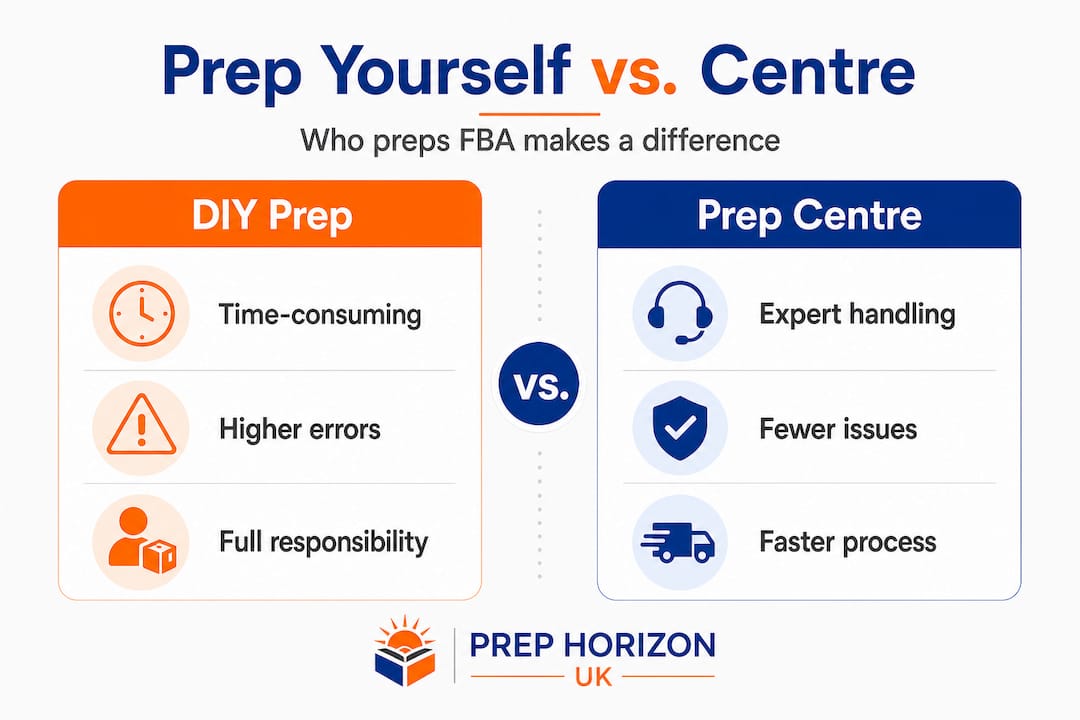
Criteria | Self-prep | FBA prep centre |
Compliance accuracy | Variable, depends on seller knowledge | Consistently high, specialist expertise |
Time required | High, especially at volume | Minimal for the seller |
Speed to Amazon warehouse | Depends on seller capacity | Faster, with established processes |
Error rate | Higher risk of mislabelling or poor packing | Lower due to quality checks |
Scalability | Limited by space and resource | Scales with your order volume |
Cost predictability | Hidden costs in time and materials | Clear, per-unit pricing |
The benefits of using a dedicated prep centre are particularly apparent when volumes increase or when sellers are managing multiple product categories with different prep requirements. The top three practical advantages are:
Consistent compliance: A specialist centre knows Amazon’s requirements in detail and updates its processes when those requirements change, so your shipments are always in line.
Faster turnaround: Prep centres handle high volumes efficiently, meaning your inventory reaches Amazon’s fulfilment network more quickly and becomes available to customers sooner.
Reduced account risk: Fewer prep errors mean fewer defective orders, fewer customer complaints, and stronger performance metrics across the board.
As FBA performance data reinforces, seller experience is directly tied to performance measurement. Outsourcing prep to specialists is one of the most direct ways to protect your metrics without adding headcount or operational complexity.
Learning how to prep inventory for FBA is valuable even if you plan to outsource, because it helps you communicate clearly with your prep partner and spot any quality issues early. Similarly, understanding the principles behind streamlining your prep process gives you a framework for evaluating whether a centre is operating efficiently on your behalf.
Pro Tip: When evaluating a prep centre, ask for specific evidence of their compliance record. A good centre will be transparent about their error rates, their familiarity with Amazon’s current packaging guidelines, and how they handle discrepancies when inventory arrives damaged or incorrectly manifested.
A fresh perspective on the FBA seller experience: What most guides overlook
Most FBA guides hand you a checklist. Tick these boxes, stay below this threshold, avoid those mistakes. That is useful as far as it goes. But it misses something important about what separates sellers who merely survive on Amazon from those who consistently grow.
Long-term FBA success is not primarily about compliance. It is about agility. The sellers who do best are not the ones who have memorised every policy document. They are the ones who have built operations flexible enough to absorb change without panic. When Amazon updates its prep requirements or shifts its storage fee structure, an agile seller adapts within days, not weeks.
That agility is almost impossible to achieve when you are doing everything yourself. The DIY approach to FBA works at low volumes, but it creates fragility. You become the bottleneck. When fee changes land, you are simultaneously doing the prep, recalculating margins, managing listings, and handling customer queries. Something gives.
This is why partnerships matter more than most guides acknowledge. A reliable prep centre, a good freight forwarder, and a clear system for monitoring policy changes collectively create the operational buffer that lets you focus on strategic decisions rather than firefighting. The fast FBA shipping strategies that experienced sellers rely on are rarely self-built. They are built through relationships.
There is also a mindset dimension that rarely gets discussed. Many sellers approach Amazon as a fixed system to be optimised once and then maintained. In reality, Amazon is a dynamic platform that demands continuous adaptation. The sellers who frame this as interesting rather than threatening tend to outperform because they actively seek out changes before they become problems.
The uncomfortable truth is that the FBA seller experience is largely self-determined. You can choose to be reactive, scrambling whenever Amazon shifts the rules. Or you can choose to be proactive, building the kind of lean, partnership-driven operation that absorbs shocks and keeps metrics strong regardless of what changes. The difference between those two positions is not luck. It is structure.
Enhance your FBA journey with Prep Horizon UK
For those ready to apply these lessons and elevate their FBA seller journey, partnering with a proven prep centre can make all the difference. Proper prep is not an optional extra. It is the operational foundation on which strong metrics, reliable fulfilment, and sustainable growth are built.

At Prep Horizon UK, we work with UK-based Amazon sellers to ensure every shipment is received, inspected, labelled, and dispatched in full compliance with Amazon’s current requirements. Our clear communication and quick turnaround times mean you spend less time worrying about logistics and more time building your business. Whether you are scaling up volumes or entering new product categories, our affordable FBA prep services are designed to keep your operation running smoothly. Visit the Prep Horizon UK website to learn how we can support your next stage of growth.
Frequently asked questions
What are the top metrics affecting FBA seller experience?
The core FBA performance measures are Order Defect Rate, Perfect Order Percentage, customer feedback, return dissatisfaction, and Inventory Performance Index. Each one directly influences your seller status and account privileges on Amazon.
How do policy or fee changes impact sellers using FBA?
Frequent updates to fees and requirements create a margin squeeze for FBA sellers, reducing profitability and increasing the pressure to stay compliant at all times. Sellers who monitor these changes proactively are far better positioned to adapt without disruption.
How can a prep centre improve my FBA seller experience?
A prep centre handles compliance, labelling, and packing to Amazon’s standards, directly reducing the prep errors that lead to metric declines and performance warnings. For UK sellers managing volume, this is one of the most effective ways to protect your account standing.
Is the FBA seller experience the same for all sellers?
No. Factors including product category, business scale, prep capability, and available resources mean that two sellers using FBA can have entirely different experiences. Sellers with structured operational support consistently report smoother, more predictable outcomes than those managing everything independently.
Recommended
Comments