
FBA prep for new sellers: A step-by-step UK guide

Many new Amazon sellers assume FBA prep is simply a matter of boxing up products and sending them off. It is not. FBA prep involves labelling, packaging, bundling, and strict compliance with Amazon’s rules across every single unit in your shipment. Miss one requirement and your stock could be refused at the fulfilment centre, sent back at your expense, or held up for weeks. This guide breaks down every key prep step, highlights the mistakes that catch new sellers off guard, and explains how a professional prep service can take the pressure off from day one.
Table of Contents
Key Takeaways
Point | Details |
FBA prep is essential | Proper FBA prep keeps your stock compliant with Amazon and prevents costly shipment problems. |
Master each prep step | Inspection, labelling, packaging, and bundling all have detailed rules new sellers must get right. |
Services offer peace of mind | Using a trusted FBA prep service can save time, lower errors, and support steady business growth. |
Invest early for success | Understanding and delegating FBA prep from day one sets new sellers up for smoother growth and fewer headaches. |
What is FBA prep and why does it matter for new sellers?
FBA stands for Fulfilment by Amazon. When you use FBA, Amazon stores your stock, picks orders, packs them, and handles delivery to customers. Sounds simple enough. But before your products ever reach an Amazon warehouse, they must meet a detailed set of preparation standards. That preparation process is what we call FBA prep.
For new sellers, FBA prep is often the first major stumbling block. You might source a brilliant product, create a well-optimised listing, and then watch your launch grind to a halt because your shipment is rejected at the door. Amazon does not make exceptions. If your goods are not prepared correctly, they are turned away.
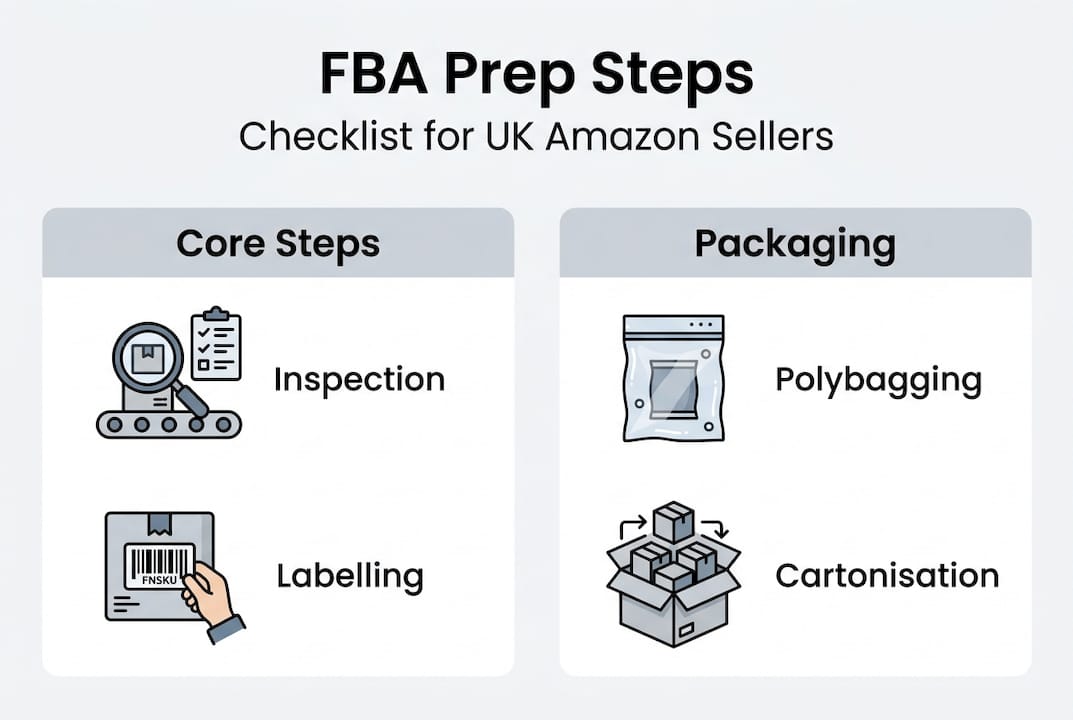
Core steps for FBA prep include inspection, FNSKU labelling, polybagging, bundling, and cartonisation, each governed by precise requirements. FNSKU stands for Fulfilment Network Stock Keeping Unit. It is a unique barcode Amazon assigns to your product, and every unit must carry one. Without it, Amazon cannot track your inventory in their system.

Beyond labelling, packaging rules are equally strict. Polybags must display suffocation warnings if they exceed a certain size. Cartons cannot exceed weight limits. Loose fill packing materials like polystyrene chips are banned entirely. These are not guidelines you can approximate. They are hard rules.
Understanding how FBA prep services simplify your business can help you appreciate just how many moving parts are involved. And the consequences of getting things wrong are not minor. Refused shipments mean delayed launches, lost ranking momentum, and unexpected return costs. For a new seller operating on tight margins, that kind of setback can be genuinely damaging.
New sellers often underestimate prep complexity. The FBA prep requirements guide covers everything from sticker placement rules to banned packing materials — details that trip up even experienced sellers.
With the stakes clear, let’s unpack every essential FBA prep step for new Amazon sellers.
Breaking down the FBA prep process: Step by step
Knowing the process in order makes it far less overwhelming. Here is how a compliant FBA prep workflow looks from start to finish.
Product inspection. Before anything else, check every unit for damage, incorrect labelling, or manufacturing defects. Sending damaged stock to Amazon wastes fees and risks negative reviews.
FNSKU labelling. Apply your Amazon-issued barcode to each unit. The label must fully cover any existing manufacturer barcode. Placement matters too — it should be flat, scannable, and not placed on a seam or curved surface.
Polybagging. Any product that could come apart, attract dust, or poses a risk needs to be in a polybag. Bags over 5 inches must carry a suffocation warning printed clearly on the bag itself.
Bundling. If you are selling multi-unit sets, bundle them securely so they cannot be separated. Each bundle needs its own FNSKU label and must be marked as a set.
Cartonisation. Pack your units into cartons within Amazon’s weight limit — typically mandatory steps include FNSKU labelling and compliance packaging. In the UK, cartons must not exceed 23kg. Label each carton with the correct shipment ID and box content information.
Palletisation. For larger shipments, Amazon may require pallets built to specific dimensions and wrapped securely. This is more common for wholesale volumes.
Pro Tip: Use the FBA shipment inspection checklist before sealing any carton. Running through a checklist takes minutes but can prevent days of rework after a rejection.
One detail that surprises many new sellers: Amazon’s system is highly automated. Scanners read your labels at high speed. A wrinkled label, a label placed on a seam, or a partially covered barcode can all cause a scan failure and trigger a rejection. The FNSKU labelling service offered by specialist prep centres uses professional-grade label applicators precisely to avoid this problem.
A useful figure to keep in mind: industry data consistently shows that labelling errors account for the majority of FBA shipment compliance failures. Getting this one step right dramatically reduces your rejection risk.
Understanding why prep matters, let’s look at the most common slip-ups and how new sellers can avoid them.
Common pitfalls new sellers face and how to avoid them
Even with a clear process, it is easy to make mistakes. Here are the errors that repeatedly catch out new UK sellers.
Labelling errors. Using the wrong barcode, applying a label that only partially covers the manufacturer code, or forgetting to label a unit entirely. Any of these will cause your shipment to fail.
Ignoring polybag rules. Sellers often polybag products without adding the required suffocation warning. Amazon checks this and will reject non-compliant units.
Overweight cartons. Cartons exceeding 23kg are refused. New sellers frequently misjudge this when packing dense products like books or ceramics.
Bundle confusion. Incorrectly packed sets or sets without the right labelling cause delays. Amazon is strict about what qualifies as a legitimate bundle.
Rushing without a checklist. Time pressure leads to skipped steps. Failing to follow Amazon’s prep policies including labelling and packaging is a leading cause of seller complaints across the platform.
Slow down before you seal the box. Every step you skip becomes a problem you pay for later — in return shipping costs, delayed inventory, and lost sales velocity during your launch window.
Logistics errors in e-commerce more broadly are a major source of business disruption, and FBA prep mistakes follow the same pattern. Small errors compound quickly.
Pro Tip: Create a prep checklist specific to each product type you sell. A polybag product has different rules to a boxed item or a bundle. Treating every product the same is a recipe for missed steps.
Review the Amazon prep requirements in detail for each category you sell in, and cross-reference against what matters in FBA prep before booking your first shipment.
To avoid these prep headaches, many sellers turn to FBA prep services — here’s how they work and what to look for in the UK market.
FBA prep services: What to expect and how to choose in the UK
Third-party FBA prep centres offer inspection, labelling, and packaging to Amazon’s exact specifications, taking the entire compliance burden off your hands. Your supplier ships directly to the prep centre. The team inspects, labels, packs, and creates your shipment, then sends it to Amazon on your behalf. You focus on sourcing and selling.
Here is what a good UK prep service should cover:
Product receiving and inventory logging
Inspection for damage and quantity verification
FNSKU labelling with professional applicators
Polybagging and suffocation warning compliance
Bundling and cartonisation within Amazon’s limits
Shipment plan creation and booking
Clear communication and tracking at every stage
The benefits of full-service logistics are well documented across e-commerce sectors, and FBA prep is no different. When a specialist handles compliance, error rates drop significantly.
When choosing a prep centre, ask these questions:
Factor | What to look for |
Pricing | Clear per-unit costs with no hidden fees |
Amazon UK experience | Familiarity with UK-specific rules and weight limits |
Turnaround times | Fast processing that protects your launch schedule |
Communication | Regular updates, not silence until problems appear |
Services included | Full-service vs. à la carte options |
A useful comparison to make is DIY prep versus using a professional centre. DIY gives you control but demands time, equipment, and deep knowledge of Amazon’s ever-changing rules. A prep centre trades a per-unit fee for speed, accuracy, and peace of mind. For most new sellers, that trade is worth making — especially early on when mistakes are most costly.
Browse the FBA prep services comparison to understand exactly what separates a reliable prep partner from one that cuts corners.
Why mastering FBA prep early pays lifelong dividends
Here is an honest perspective from those who have seen sellers navigate the FBA prep learning curve firsthand. The sellers who struggle most are not the ones who lack drive. They are the ones who treat prep as an afterthought — something to sort out quickly before moving on to the exciting parts of selling.
Shortcuts in prep create a compounding problem. One bad shipment leads to a refund request for return shipping. A second rejection erodes your launch momentum. A third makes you question whether FBA is even worth it. The real cost is not just financial. It is the confidence knock that causes new sellers to slow down precisely when they should be speeding up.
The sellers who thrive build a reliable prep system early, whether that means investing time in learning the rules themselves or partnering with a service that handles it for them. Either route works. What does not work is improvising. If you are preparing inventory for FBA without a repeatable process, you are leaving risk on the table with every shipment you send. Treat FBA prep as a core business function, not a box-ticking exercise, and it will pay you back in smoother launches, fewer headaches, and room to scale.
Make your Amazon launch stress-free with expert FBA prep
Armed with practical tips and insider perspective, you are ready to transform FBA prep from a headache into a competitive advantage.

At our trusted FBA prep centre, we handle the entire prep process for UK Amazon sellers — from receiving your supplier’s shipment to creating your Amazon shipment plan. Inspection, FNSKU labelling, polybagging, bundling, cartonisation. All done to Amazon UK’s exact standards, with clear communication throughout. Our affordable FBA prep services are priced transparently so you always know what you are paying. Whether you are launching your first product or scaling an existing catalogue, we are here to make your prep process fast, compliant, and stress-free from day one.
Frequently asked questions
What is FBA prep and do I need it for every Amazon shipment?
FBA prep is mandatory for Amazon-fulfilled shipments and covers inspection, labelling, packaging, and bundling to meet Amazon’s strict compliance rules. Yes, every shipment to an Amazon fulfilment centre must be correctly prepped without exception.
What happens if I skip FBA prep steps or make mistakes?
Skipping prep steps leads to stock refusals, costly returns, or significant delays, all of which eat into your margins and harm your launch timeline.
Is it better to use a professional FBA prep service in the UK or do everything myself?
Third-party FBA prep centres manage every aspect of the prep process to Amazon’s standards, reducing errors and saving you significant time, while DIY prep offers control at the cost of higher compliance risk.
Are there specific FBA prep rules for the UK?
Amazon UK outlines specific requirements for packaging, labelling, carton weights, and shipment policies that all sellers must follow before sending stock to UK fulfilment centres.
Recommended
Comments