
Streamline your FBA prep documentation for smoother sales

One missing box label. That is all it takes to have an entire shipment rejected at an Amazon UK fulfilment centre, costing you days of delays and potentially missing a key sales window. For too many sellers, FBA prep documentation feels like bureaucratic box-ticking, but it is actually the backbone of a reliable, scalable Amazon business. Get it right and your inventory flows smoothly from supplier to shelf. Get it wrong and you are chasing customer service tickets while your competitors make sales. This article cuts through the confusion and gives you clear, actionable guidance on every document you need, what compliance actually looks like, and how to make the whole process work in your favour.
Table of Contents
Key Takeaways
Point | Details |
Compliant documentation prevents delays | Ensuring all FBA prep documentation is correct means your shipments reach Amazon without hold-ups. |
Cost savings through accuracy | Accurate paperwork and prep help avoid wasted fees and speed up release to Amazon warehouses. |
Proper prep boosts sales performance | Well-documented and prepared shipments create a smoother supply chain and happier customers. |
Avoid common pitfalls | Simple checklists and updating with Amazon’s latest requirements keep errors low and compliance high. |
Understanding FBA prep documentation essentials
FBA prep documentation refers to the complete set of paperwork, labels, and records that accompany your inventory from the point of preparation through to acceptance at an Amazon fulfilment centre. This includes commercial invoices, packing lists, carton content lists, FNSKU barcode labels, box labels, and pallet labels for larger freight shipments. Each document plays a specific role in helping Amazon receive, identify, and locate your products quickly and accurately.
When inventory arrives at a fulfilment centre, Amazon’s receiving team runs through a structured check. They verify that box contents match the carton content list, that each unit carries the correct FNSKU label, and that the shipment dimensions and weights fall within their published limits. If anything is off, the shipment can be refused, held, or subject to additional prep fees charged by Amazon itself, which are significantly higher than using a third-party prep requirements guide.

Understanding the weight and size rules is non-negotiable. As outlined in Amazon’s own carton guidance, the maximum carton weight for UK shipments is 23kg, and any box weighing between 15kg and 23kg must carry a heavy package label. No single side of a box may exceed 63.5cm. For pallet shipments, the load must be shrink-wrapped and stable before collection. Missing any of these physical requirements is one of the most common reasons shipments are turned away.
The knock-on effect of poor documentation reaches far beyond a single rejected delivery. Disputes with freight carriers, stock reconciliation headaches, and delayed reimbursements all trace back to incomplete paperwork. Sellers who invest time in preparing inventory for FBA correctly from the outset find that disputes are resolved faster because there is a clear paper trail.
Key physical limits to memorise for UK FBA shipments:
Maximum box weight: 23kg
Heavy label required: 15kg to 23kg
Maximum single side length: 63.5cm
Pallets must be shrink-wrapped and structurally stable
Each box must carry a unique Amazon box label with shipment and carton ID
Treating documentation as an afterthought is one of the costliest mistakes an Amazon seller can make. A single missing label can freeze inventory worth thousands of pounds at the receiving dock.
Key documents and compliance checks
After covering the essentials, it is vital to know exactly which documents are needed and how Amazon assesses them at each stage of the receiving process.
Every FBA shipment involves a predictable set of documents. Each one serves a distinct compliance function, and omitting even one creates gaps that slow down or block your inventory from being checked in. Here is a breakdown of the documents you will need and what happens if they are missing:
Document | Compliance role | Risk if omitted |
Product prep sheet | Confirms prep instructions per ASIN | Wrong prep applied, units rejected |
Carton content list | Lists units per box | Miscount, reconciliation delays |
FNSKU barcode label | Identifies each unit to your seller account | Unit not linked to your account, lost inventory |
Box label | Links physical box to shipment in Seller Central | Shipment not received, box quarantined |
Pallet label (LTL/FTL) | Links pallet to freight booking | Pallet refused at dock |
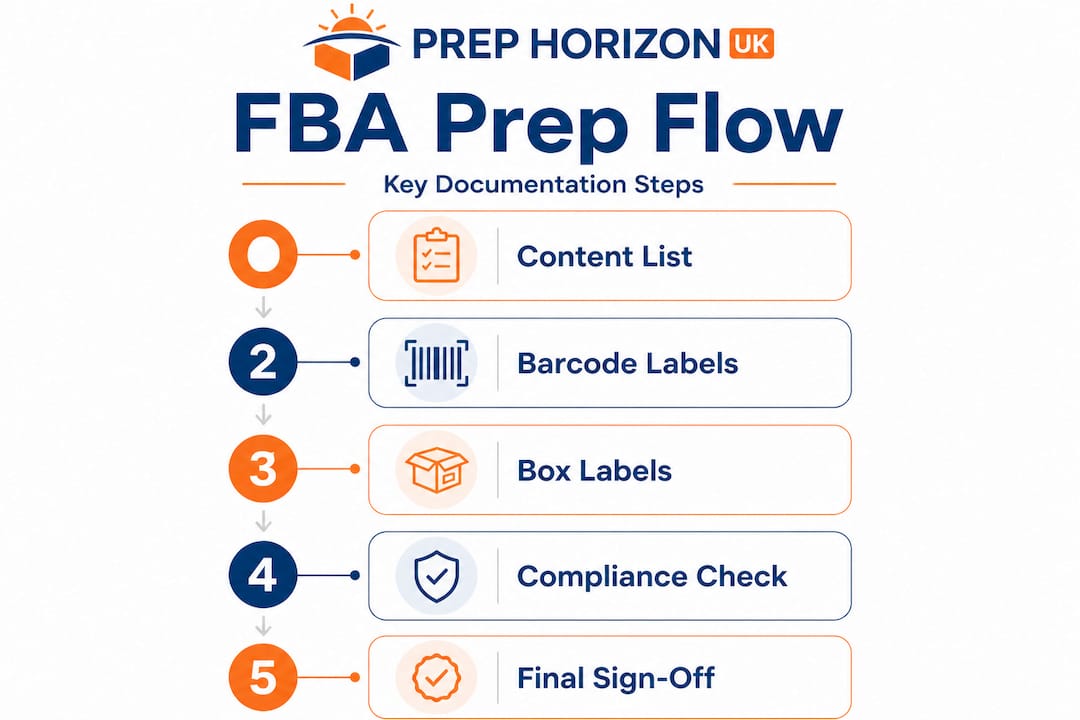
The step-by-step compliance check sequence that professional prep centres follow looks like this:
Prepare the product prep sheet for each ASIN in the shipment, confirming packaging type, poly-bagging or bubble-wrap requirements, and any bundling instructions.
Generate and print the carton content list from Amazon Seller Central, ensuring each box has a unique identifier with accurate unit counts.
Print and apply FNSKU labels to every individual unit, covering any existing manufacturer barcodes to avoid scanning conflicts.
Print box labels directly from your shipment workflow in Seller Central and affix one to each carton, ideally on the largest flat face.
For freight shipments, print and attach pallet labels to all four sides of every pallet, following the LTL shipping guide for correct placement and orientation.
Conduct a final cross-check using the shipment inspection checklist before the carrier collects.
Box and pallet weight limits remain critical at this stage. Boxes exceeding 23kg will be refused regardless of how accurately labelled they are. This is where many sellers trip up: they get the labelling right but allow a supplier to overpack a carton. Confirm physical dimensions and weights before labels are generated.
Every label must be printed clearly, without smudging, and positioned where a scanner can reach it without opening the box. Laser printing on white label stock is the industry standard. Thermal printing works well for high-volume operations.
Cost and turnaround: what efficient FBA prep looks like
Good documentation directly reduces hassle and cost. Now let us translate compliance into boosted efficiency and better margins, because knowing the numbers helps you plan with confidence.
Prep fees in the UK market vary by service type and volume. Based on current industry benchmarks, labelling costs between £0.13 and £0.50 per unit, poly-bagging runs from £0.20 to £0.55 per unit, and bubble-wrap protection sits between £0.45 and £0.70 per unit. Standard box preparation costs between £2.00 and £3.50 per carton. Turnaround times at reputable centres typically run between 24 and 48 hours, provided documentation arrives correctly formatted.
Volume matters significantly to your per-unit cost. Here is how the tiers generally break down:
Volume tier | Labelling cost per unit | Poly-bagging cost per unit | Expected turnaround |
1 to 200 units | £0.45 to £0.50 | £0.50 to £0.55 | 48 hours |
201 to 999 units | £0.35 to £0.45 | £0.35 to £0.50 | 24 to 48 hours |
1,000 plus units | £0.13 to £0.35 | £0.20 to £0.35 | 24 hours |
These figures highlight why documentation quality connects directly to cost efficiency. When a prep centre receives a shipment with incomplete or incorrect documentation, staff must stop, investigate, and wait for clarification. That delay pushes your inventory past the standard turnaround window, sometimes triggering rework fees. Sellers who arrive with clean, complete documentation consistently benefit from faster processing and lower overall costs. You can review our current FBA prep price list to see exactly how this plays out in practice.
There are also meaningful cost-saving prep ideas that go beyond simply choosing a lower-cost centre. Batching similar ASINs together, pre-sorting units by size before delivery, and sending pre-formatted carton content lists all reduce the manual handling time at the centre and bring your bill down.
Pro Tip: Build a digital documentation template for each ASIN you regularly send to Amazon. Include the prep instructions, label type, and box weight limits in one reusable file. Sharing this with your prep centre before each shipment eliminates back-and-forth and speeds up every single dispatch.
Avoiding common FBA prep documentation mistakes
Now you know the costs and process benefits, so let us ensure you do not fall into avoidable traps that eat into your margins and create unnecessary stress.
The five most common documentation errors that lead to rejected or delayed FBA shipments are predictable, and that is actually good news because predictable problems are preventable ones.
Missing or misplaced box labels are the single most frequent issue. A box label that is partially peeled, printed at low resolution, or placed on a flap that gets folded away during transit will fail to scan at the receiving dock.
Exceeding the maximum carton weight catches many sellers off guard, particularly those sourcing heavier goods like electronics, fitness equipment, or ceramics. Even when the label is perfect, a box over 23kg gets refused. Pair your documentation checks with a physical weight check at the packing stage.
Unclear or missing invoices create problems during customs clearance for cross-border stock and during any Amazon reimbursement claims. An invoice with vague product descriptions or no unit count is not useful to anyone in a dispute.
Wrong prep instructions on the product sheet happen when sellers update their packaging but forget to update the instruction document sent to the prep centre. The result is units prepared incorrectly, triggering rework at extra cost.
Skipping pallet stabilisation and labelling for LTL or FTL shipments is a fast route to a refused delivery. Shrink-wrap is not optional. Pallet labels on all four sides are not optional.
Here is a quick-reference list of errors and their consequences:
Missing box label: shipment quarantined, processing delayed by two to five days
Overweight carton: refused at dock, return freight cost falls on seller
Vague invoice: customs hold, reimbursement claims unsupported
Incorrect prep instructions: rework fees, potential ASIN-level suspension for repeated issues
Unstabilised pallet: refused at dock, rescheduled freight collection required
When prepping inventory for FBA, always cross-reference with Amazon’s live requirements rather than relying on notes from a previous shipment. Requirements do change, and managing FBA inventory across multiple SKUs becomes far easier when you maintain a centralised, current version of your prep standards.
Pro Tip: Run a two-person sign-off on every shipment before it leaves for the prep centre or fulfilment centre. One person prepares the documentation, another checks it against the physical goods. This simple step cuts error rates dramatically.
What most guides miss about FBA prep documentation
Most FBA guides treat documentation as a compliance hurdle, something to clear and then forget. That framing misses the bigger opportunity entirely.
Documentation is a strategic asset. The sellers who consistently outperform their competition on Amazon UK are not always the ones with the lowest prices or the flashiest listings. They are often the ones whose back-office operations are simply tighter. When your carton content lists are accurate and your FNSKU labels are applied consistently, you generate reliable data about what you are sending, when, and at what cost. That data feeds directly into better purchasing decisions, smarter reorder timing, and more accurate cashflow forecasting.
Think about what organised documentation actually gives you. You can reconcile inventory discrepancies faster because your records match Amazon’s. You can negotiate better freight rates because you can demonstrate consistent shipment quality to carriers. You can onboard new suppliers more quickly because your prep standards are written down and transferable, rather than living in someone’s head.
There is also a less obvious benefit: speed to market. Sellers who treat documentation as a process to optimise rather than a task to complete find that their FBA sales accelerate naturally. Clean shipments move faster through receiving, meaning your stock becomes available for purchase days sooner. In competitive categories, those extra days of availability during a peak period can be the difference between a strong month and a missed opportunity.
The uncomfortable truth is that most sellers who struggle with FBA prep are not struggling because of a lack of knowledge. They are struggling because they have not built a repeatable system. Documentation is where that system lives.
Streamline your FBA prep documentation with expert support
Managing every label, checklist, and carton content list in-house is entirely possible, but it absorbs time that most growing sellers would rather invest in sourcing, marketing, and customer acquisition. When documentation errors cost you sales velocity and rework fees pile up, the maths shifts firmly in favour of professional support.

At Prep Horizon UK, we handle the full documentation and preparation workflow on your behalf, from receiving and inspection through to labelling, bundling, and shipment creation. Our team works to the same 24 to 48 hour turnaround benchmarks that keep your inventory moving without gaps. Whether you are sending 50 units or 5,000, our FBA prep centre solutions scale with your business. We communicate clearly at every stage, so you always know exactly where your stock is and what has been completed. Explore our prep service pricing and see how a streamlined prep partnership translates into real cost savings and fewer headaches.
Frequently asked questions
What is the maximum box weight for FBA shipments to UK fulfilment centres?
The maximum is 23kg per box, with anything between 15kg and 23kg requiring a heavy package label affixed clearly to the carton before dispatch.
How quickly can FBA prep centres process and dispatch inventory?
Most prep centres offer a 24 to 48 hour turnaround for standard shipments, particularly when all documentation arrives correctly formatted and complete.
What are the typical costs for labelling and prepping items for Amazon FBA in the UK?
Labelling usually costs between £0.13 and £0.50 per unit, with overall prep fees ranging from £0.13 to £0.70 per unit depending on the service type and volume in 2026.
Which documents are essential for an Amazon FBA shipment to be accepted?
Key documents include a carton content list, FNSKU barcode labels applied to each unit, and box or pallet labels generated from Amazon Seller Central depending on whether you are shipping parcel or freight.
How can I reduce prep errors that delay my FBA shipments?
Always cross-check current Amazon prep requirements before each shipment and use digital templates or checklists per ASIN to ensure no step is skipped as requirements evolve.
Recommended
Comments