
Role of packaging in Amazon FBA: a UK seller's guide

Most UK Amazon FBA sellers treat packaging as an afterthought. Box it up, stick a label on it, ship it out. But the role of packaging in Amazon FBA reaches far beyond keeping your product intact in transit. It affects whether Amazon accepts your shipment at all, how much you pay in unplanned prep fees, how quickly your inventory becomes available for sale, and what a customer thinks of your brand the moment they open the box. Get it wrong and you pay for it in multiple ways. Get it right and it quietly becomes one of your strongest operational advantages.
Table of Contents
Understanding Amazon FBA packaging requirements and why they matter
Key packaging elements: polybags, labels and packaging structure
Handling delicate products and bundles: specialised packaging and labelling strategies
Packaging impact on costs and customer experience in Amazon FBA
Practical tips and common mistakes to avoid in your Amazon FBA packaging process
Why packaging is your secret weapon for long-term FBA success
Key Takeaways
Point | Details |
Packaging enables workflow | Effective packaging ensures smooth Amazon handling and prevents costly remedial fees. |
Correct labels are vital | Apply scannable FNSKU and shipment labels properly to avoid shipment rejection. |
Product-specific prep matters | Fragile items, liquids, and bundles need tailored packaging to meet requirements. |
Packaging affects costs and brand | Smart packaging reduces fees and improves customer satisfaction and retention. |
QC checks reduce errors | Regular scanning, warning verification, and sealed-unit photos prevent common mistakes. |
Understanding Amazon FBA packaging requirements and why they matter
Amazon’s fulfilment centres process millions of units every day. To do that at scale, everything entering those centres must conform to predictable standards. Your packaging is not just protecting the product. It is enabling Amazon’s inbound workflow: receiving, scanning, routing, and storing inventory with minimal human intervention.
The packaging requirements for compliance are clear: packaging must ensure no damage and scannable barcodes at every stage, or you will face extra fees and potential shipment rejections. That is not a guideline. It is the price of entry.
When packaging fails to meet Amazon’s standards, the consequences are immediate and costly. Amazon may charge unplanned prep fees to correct the issue on your behalf, delay your inventory going live, or reject the shipment outright. None of those outcomes are recoverable without time and money.
Here is what Amazon’s core packaging requirements cover:
Rigid, six-sided boxes with appropriate weight capacity for your products
Scannable barcodes visible on the exterior of every unit and carton
No protruding edges or loose components that could snag during automated handling
Appropriate protective materials inside cartons to prevent movement and damage
Weight and dimension compliance to avoid dimensional weight surcharges
“Prep is the seller’s responsibility. Amazon will not fix your packaging for free. If it does not meet requirements, you either pay their prep fee or your shipment gets bounced.”
Understanding prepping inventory for Amazon FBA properly from the outset saves you from the kind of fees that quietly erode your margins over time.
Key packaging elements: polybags, labels and packaging structure
Polybags are one of the most common packaging formats in FBA, particularly for soft goods, clothing, and accessories. But they come with specific rules that many UK sellers miss entirely.

Polybag safety requirements state that any polybag with an opening of five inches or more must carry a suffocation warning, and the bag itself must be at least 1.5 mil thick. Thinner bags risk tearing during handling, and missing the suffocation warning is one of the most common compliance failures at fulfilment centres.
Labelling is equally precise. Correct FNSKU and carton labels are crucial: missing or misplaced labels lead directly to extra fees and inventory rejection. The FNSKU is Amazon’s internal barcode that ties the unit to your seller account. It must be on the outside of each unit, must be scannable through any packaging, and must cover any other barcodes including manufacturer UPCs.
Key requirements for polybags and labels:
Polybag openings of five inches or wider require a printed suffocation warning
Minimum polybag thickness is 1.5 mil
FNSKU labels must be scannable and must cover existing manufacturer barcodes
Carton labels go on the outside of every shipping box, flat on the surface, not across seams
Labels must not be wrinkled, torn, obscured, or placed on corners
How to check your labelling before sealing:
Measure the opening of every polybag type you use. If it is five inches or wider, confirm the suffocation warning is printed directly on the bag.
Scan every FNSKU label with a standard barcode scanner before sealing the unit.
Check that the FNSKU fully covers the manufacturer barcode. Hold it up to a bright light to check bleed-through.
Apply carton labels to flat surfaces only. Scan the carton label once applied.
Photograph the labelled unit and carton before sealing as a quality record.
Pro Tip: Scan FNSKU barcodes through the polybag before sealing it. If the scanner cannot read it through the bag, Amazon’s automated systems will not be able to either. Resolve it before it becomes a fulfilment centre problem.
Further detail on Amazon FBA product labelling and what labels are required for Amazon FBA will help you build a consistent labelling process that holds up under volume.
Handling delicate products and bundles: specialised packaging and labelling strategies
Not every product ships in a standard box with an FNSKU label. Fragile items, liquids, and multi-product bundles each carry additional packaging obligations, and the consequences of getting them wrong are proportionally higher.
Fragile products must be packaged so they can survive a drop from a height equivalent to standard parcel handling. That means rigid outer cartons, appropriate internal cushioning such as bubble wrap or foam inserts, and no movement inside the box. If you can shake the box and hear the product move, it will not survive the fulfilment centre’s automated conveyor systems.
Liquids require sealed, leak-proof containers placed inside a secondary sealed polybag. Any polybag used must comply with suffocation warning rules where applicable. The objective is containment at every level. A leaking liquid product does not just damage your stock. It can damage adjacent inventory in the fulfilment centre, which creates an entirely different category of problem.
Bundles must be packaged as single sellable units with clear ‘Do Not Separate’ markings to avoid identity and handling issues. This is not optional. A bundle with a single FNSKU label that arrives as two separate items will be processed as two separate, unidentified units. You will pay to sort it out.
Product type | Packaging requirement | Label requirement |
Fragile items | Rigid carton, internal cushioning, drop-tested | FNSKU on exterior, no loose labels |
Liquids | Sealed container, secondary polybag | FNSKU, suffocation warning if applicable |
Multi-item bundles | Combined packaging, items secured together | Single FNSKU, ‘Do Not Separate’ label |
Soft goods | Polybag (min 1.5 mil), sealed | FNSKU, suffocation warning if applicable |
Pro Tip: Physically verify every bundle unit before sealing. Pick it up and invert it. If anything shifts or separates, the packaging is not secure enough. Relabelling bundles at a fulfilment centre is one of the most avoidable costs in FBA.
More detail on FBA prep requirements covers the full range of product-specific rules you need to follow.
Packaging impact on costs and customer experience in Amazon FBA
The financial impact of packaging decisions is felt in two directions: the fees you pay when packaging fails, and the revenue you lose when customer experience suffers. Both are packaging problems, and both are avoidable.
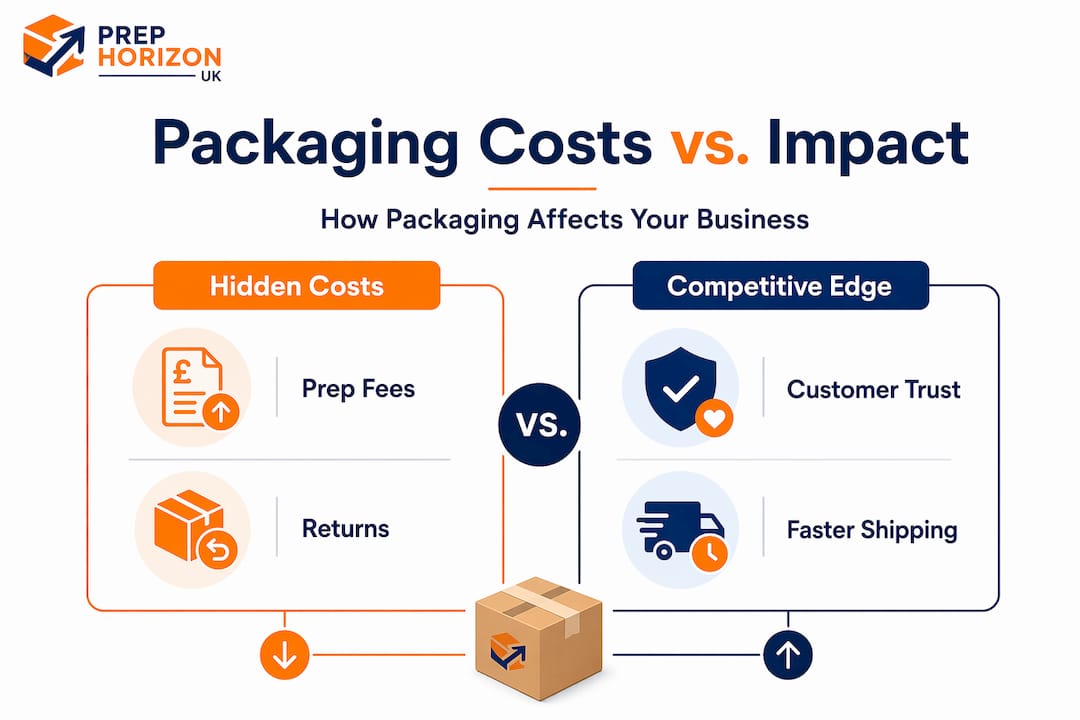
Unplanned prep fees from non-compliant packaging accumulate faster than most sellers realise. A single missed suffocation warning across a batch of 500 units can generate significant charges. Add dimensional weight fees from oversized or poorly structured cartons, and the cost of bad packaging becomes a genuine margin issue.
Smart packaging reduces handling fees and improves customer satisfaction through better presentation and brand recognition. This is where the role of branding in packaging becomes commercially relevant. A customer who receives a product in branded, thoughtfully designed packaging has a materially different experience to one who opens a plain brown box. That difference shows up in review ratings, return rates, and repeat purchases.
Packaging type | Effect on fees | Effect on returns | Customer satisfaction |
Generic, unbranded | Higher prep fee risk | Moderate return rate | Average |
Compliant, branded | Lower fee exposure | Lower return rate | Higher |
Non-compliant | High unplanned fees | High return rate | Poor |
Packaging practices that improve customer experience:
Consistent branding on outer packaging and inserts builds recognition
Protective internal packaging reduces damage-related returns
Sustainable materials appeal to environmentally aware buyers
Clean label placement signals professionalism before the product is even seen
Appropriate box sizing reduces excess void fill and looks considered
Pro Tip: When choosing packaging materials, treat sustainability as a selling point, not just a cost. UK consumers are increasingly aware of excess packaging. A well-fitted, minimal box with recycled materials can generate positive mention in reviews without a single word of marketing.
Our guides on FBA packaging compliance and preparing inventory for Amazon FBA go deeper on cost-effective FBA packaging strategies.
Practical tips and common mistakes to avoid in your Amazon FBA packaging process
Quality control is where good packaging intentions either hold up or fall apart. Most packaging errors are not design problems. They are process problems. A consistent daily checklist eliminates the majority of them.
Your daily quality control process for each batch:
Confirm suffocation warning on every polybag with an opening of five inches or wider.
Scan every FNSKU label through its packaging to confirm barcode clarity.
Check carton integrity: no soft spots, no damaged corners, no open seams.
Confirm the correct FBA shipment label is applied to each carton, flat on the surface.
Photograph each sealed unit and carton as a batch record before despatch.
The most common packaging mistakes UK FBA sellers make:
Missing suffocation warnings on polybags of the required width
Leaving manufacturer UPC barcodes uncovered beneath FNSKU labels
Using incorrect box types such as round or irregular containers that Amazon’s systems cannot process
Label misplacement across corners or seams where scanners cannot read them
Insufficient internal cushioning leading to product movement and damage
A ‘scan and seal’ check with sealed-unit photo proof prevents later prep fees and helps trace issues when they arise. This is not bureaucracy. It is evidence. When Amazon raises a query about a specific batch, a photo record resolves it in minutes rather than weeks.
“The sellers who avoid prep fees consistently are not the ones with the most expensive packaging. They are the ones with the most disciplined process. A checklist costs nothing. An unplanned prep fee costs real margin.”
For a deeper look at process discipline, mastering FBA inventory prep covers the full picture of what a reliable prep workflow looks like.
Why packaging is your secret weapon for long-term FBA success
Here is the perspective that most packaging guides will not give you: packaging is not a compliance burden. It is a margin protection mechanism and a brand-building opportunity wrapped in the same physical object.
Every seller who treats packaging as a necessary cost to minimise is making a category error. Thin polybags save pence. Failed shipments cost pounds. Cheap void fill saves money on Tuesday and generates a damage return on Friday. The maths do not work in favour of cutting corners.
Packaging quality drives fewer prep fees, faster fulfilment, and boosts customer retention through brand experience. That is not a marketing claim. It is an operational reality. When your packaging enables Amazon’s workflow smoothly, your inventory goes live faster, your fulfilment rate stays clean, and your seller metrics remain healthy.
The sellers who win long-term on Amazon are not the ones with the lowest packaging costs. They are the ones who understand that packaging is part of the product. The unboxing moment is the only physical interaction your customer will ever have with your brand. A branded insert, a well-fitted box, and a product that arrives undamaged does more for your next sale than most advertising spend.
Our guide to FBA packaging compliance in the UK is a practical starting point if you want to build a packaging process that earns you operational advantages rather than just avoiding penalties.
Enhance your Amazon FBA packaging with expert prep services
Knowing the rules is one thing. Applying them consistently across every batch, every product type, and every volume spike is where most UK sellers struggle.

At Prep Horizon UK, we handle the full packaging and prep process for Amazon FBA sellers, including polybagging, FNSKU labelling, bundle assembly, carton labelling, and quality control checks before every shipment. Our team works to Amazon’s current requirements so your inventory arrives compliant, scannable, and ready to sell. We offer transparent prep pricing built for UK sellers at every scale, from start-ups managing their first hundred units to established sellers running high-volume weekly shipments. Let us take the packaging burden off your plate so you can focus on sourcing and sales.
Frequently asked questions
What are the essential packaging requirements for Amazon FBA in the UK?
Amazon requires sturdy, six-sided boxes or compliant polybags with scannable FNSKU labels, suffocation warnings on polybags with openings of five inches or wider, and strict packaging standards including protective internal materials to prevent damage during handling and transit.
How should I label my products and cartons for Amazon FBA?
Each unit must carry a scannable FNSKU barcode covering any other barcode on its exterior, and all shipping cartons need a correctly placed FBA shipment label on a flat surface. Correct unit and carton labelling is essential to avoid extra fees and ensure inventory acceptance.
What special packaging rules apply to bundles or sets for Amazon FBA?
Bundles must arrive as a single sellable unit with one FNSKU label, secured so no items can separate, and marked with ‘Do Not Separate’ labels. Bundle packaging discipline prevents mis-handling and the additional fees that come from items being processed separately.
Why is proper packaging important beyond protecting products?
Good packaging enables Amazon’s automated handling and scanning processes, reducing unplanned prep fees and avoiding shipment delays. Packaging quality also directly shapes the customer unboxing experience, which affects reviews, return rates, and brand loyalty.
How can I avoid common packaging mistakes that lead to extra fees?
Run a daily quality control checklist including barcode scanning before sealing and photographing each batch. Scan and seal checks combined with photo proof help prevent prep fees and give you a clear record to resolve any fulfilment centre queries quickly.
Recommended
Comments