
Master Amazon inventory prep and streamline your FBA business

Amazon FBA promises to simplify selling, but many UK sellers discover the hard way that the platform does not manage everything for you. Before your products ever reach an Amazon fulfilment centre, they must pass through a meticulous preparation process that determines whether your shipment sails through or gets rejected at the door. Inventory preparation ensures products meet Amazon’s strict requirements before arriving at fulfilment centres, and getting it wrong costs real money. This guide walks you through every aspect of FBA inventory prep, from the foundational steps to expert strategies that give UK sellers a genuine competitive edge.
Table of Contents
Key Takeaways
Point | Details |
Prep is crucial | Proper inventory prep prevents costly Amazon delays and keeps your business running smoothly. |
Outsourcing advantages | Using a UK prep centre saves time, reduces errors, and supports scalable growth. |
Avoid common errors | Most shipment issues come from labelling and packaging mistakes, which can be prevented with careful checks. |
Prep impacts sales | Reliable prep helps you deliver fast and dependable service, winning better reviews and loyal buyers. |
What is Amazon inventory prep?
Inventory prep is the full set of tasks you must complete before sending stock to an Amazon fulfilment centre. It is not simply a matter of putting items in a box and printing a shipping label. Every product must conform to Amazon’s specific standards for labelling, packaging, and presentation, and those standards are detailed, regularly updated, and strictly enforced.
At its core, inventory prep essentials cover the following key activities:
Labelling and barcoding: Every unit must carry the correct Amazon barcode (FNSKU), placed accurately so scanners can read it without obstruction.
Polybagging and shrink wrapping: Loose, fragile, or multi-part products must be enclosed in compliant polybags or wrapping to prevent damage and contamination.
Bundling and kitting: Products sold as a set must be properly combined, labelled as a bundle, and packaged so they cannot be separated in transit.
Quality inspection: Every item should be checked for defects, damage, or discrepancies before it leaves your hands.
Shipment creation and verification: Shipment plans must be created correctly within Seller Central, and box content information must match what is physically packed.
Skipping or rushing any of these stages creates downstream problems. Amazon’s fulfilment centres process millions of units every week, and they rely on sellers providing perfectly prepared stock. When your prep is off, the consequences range from delayed check-in to outright rejection and additional charges billed directly to your account.
“Inventory preparation is not optional admin — it is the foundation of a reliable FBA operation. Get it right consistently and your metrics improve, your costs drop, and your customers receive exactly what they ordered.”
The scale of Amazon’s requirements can catch new sellers off guard. There are separate rules for different product categories, hazmat items, glass, liquids, and products with expiry dates. Understanding these rules thoroughly before you send your first shipment is far more cost-effective than learning through rejected inventory.
Key steps in inventory preparation for Amazon FBA
Now that the purpose and scope of inventory prep are clear, let’s walk through the essential steps involved for every FBA seller.
A structured, repeatable process is your best protection against costly errors. Sellers who treat prep as an informal task tend to make inconsistent mistakes that accumulate over time. Sellers who follow a defined step-by-step process build efficiency and reliability into their operation from the ground up.
Product inspection and quality check. Before anything else, examine every unit for damage, manufacturing defects, or discrepancies with the original purchase order. Sending defective stock to Amazon is a quick route to negative customer feedback and removal orders.
Labelling and barcoding. Print and apply FNSKU labels that precisely match each product listed in your Seller Central account. Labels must be correctly sized, legible, and positioned so they do not cover original manufacturer barcodes or product information. Amazon’s label placement rules are specific, and barcode scanners at fulfilment centres are unforgiving.
Packaging. Choose the correct packaging method for the product type. Liquids require sealed polybagging with a suffocation warning if the bag opening exceeds a certain size. Fragile items need bubble wrap or foam protection. Products with multiple components must be secured together. Each packaging choice must meet Amazon’s minimum drop-test requirements.
Bundling or kitting. If you sell product bundles (for example, a skincare set or a kitchen accessories kit), each bundle must be treated as a single unit. This means one FNSKU label for the entire bundle, packaging that keeps all components together, and clear labelling indicating the bundle contents and quantity.
Final shipment verification. Before sealing boxes, cross-check every unit against your shipment plan in Seller Central. Box content information must be accurate. Weight and dimension data for boxes must be correct. Inaccurate box content information results in manual check-in by Amazon staff, which adds time and may trigger additional charges.
FBA prep requirements are detailed in Amazon’s official documentation, and meticulous preparation minimises the risk of rejected shipments and costly Amazon penalties.
Pro Tip: Create a printed prep checklist specific to each of your product types. When your team (or your prep centre) follows the same checklist every time, error rates drop dramatically and consistency becomes the default rather than the exception.
DIY vs professional inventory prep centres: a comparison
With the step-by-step process outlined, you may be wondering whether to handle prep yourself or trust a professional. Let us examine both options honestly.
Doing your own inventory prep has a certain appeal, particularly when you are just starting out. You have direct control, you avoid service fees, and for very small volumes, it can be manageable. However, as soon as your order volumes increase, DIY prep introduces significant risks and hidden costs.

The time you spend labelling, packaging, and verifying shipments is time you are not spending on sourcing, marketing, or growing your catalogue. Errors made in-house can result in rejected shipments, Amazon non-compliance fees, and even account health warnings. Physical space, equipment (label printers, scales, packaging materials), and staffing add further overheads that many sellers underestimate.
Outsourcing to a prep centre saves time and reduces error rates, particularly for scaling sellers who cannot afford to have their account health compromised by avoidable mistakes.
Factor | DIY prep | Professional prep centre |
Time investment | High — owner or staff time | Low — handled by specialists |
Compliance accuracy | Variable — depends on training | High — centres stay current on rules |
Error risk | Higher, especially at volume | Lower, with quality control processes |
Scalability | Limited by space and capacity | Scales with your order volume |
Upfront cost | Low initially | Service fees apply |
Operational stress | High during peak periods | Significantly reduced |
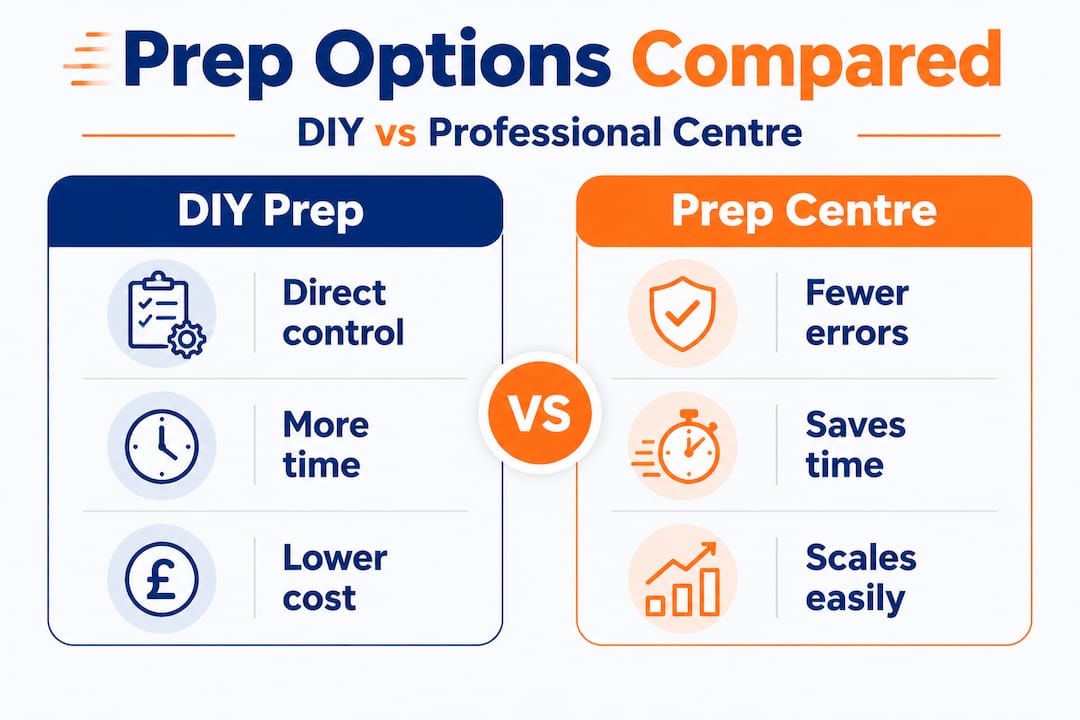
The table makes the trade-offs clear. For sellers processing fewer than fifty units per month, DIY may be viable. For anyone scaling beyond that, the operational friction of in-house prep starts to hurt growth. You can read more about the differences in this prep centre vs in-house breakdown.
Key benefits of professional prep centres for UK FBA sellers:
Consistently compliant labelling and packaging without needing to train internal staff
Faster turnaround times than most in-house operations can achieve
No need to maintain warehouse space or invest in equipment
Expert handling of complex categories such as hazmat, fragile goods, and bundled products
Detailed reporting so you always know what has been processed and shipped
Pro Tip: A hybrid approach works well for sellers managing multiple product lines. Use in-house prep for your most straightforward, high-volume products while outsourcing complex, time-consuming prep jobs (such as multi-component kits or items requiring special packaging) to a professional centre. This approach optimises costs without sacrificing compliance.
Common pitfalls and mistakes in Amazon inventory prep
Understanding the options is important, but preparing inventory is rarely error-free. Here is what often goes wrong in practice, and how to protect yourself.
Even experienced sellers make prep mistakes. The difference between a struggling operation and a smooth one often comes down to recognising the most common errors and building systems to prevent them.
Errors in labelling or packaging are among the top reasons for Amazon FBA shipment rejections, and the financial impact is significant. Here are the pitfalls that trip sellers up most frequently:
Incorrect or missing FNSKU labels. This is the single most common prep error. Applying the wrong label to a product, or placing it in a position that obscures original barcodes, causes check-in failures.
Non-compliant packaging. Polybags without suffocation warnings, packaging that does not meet drop-test standards, or insufficient cushioning for fragile items all create problems at the fulfilment centre.
Ignoring Amazon policy updates. Amazon updates its prep requirements periodically. Sellers who relied on last year’s rules without checking for changes often find their shipments failing new compliance standards.
Inconsistent quality control. Sending a mix of checked and unchecked units is a recipe for customer complaints. One defective item reaching a buyer can generate a negative review that harms your entire listing.
Inaccurate box contents or weights. Declaring the wrong number of units per box or submitting incorrect weight data adds delays and potential fees when Amazon processes your shipment manually.
“One rejected pallet can wipe out the profit margin on an entire order. The cost of getting prep wrong is never just the immediate fix — it is the time lost, the account health impact, and the customers who do not get their orders on time.”
Using an inspection checklist tailored to your products is one of the most practical tools available. It takes minutes to complete but catches errors before they become expensive.
Leveraging prep centres to streamline your FBA operation
Having covered common pitfalls, let’s explore how professional prep centres can take your FBA operation to the next level.
A UK-based FBA prep centre acts as the operational backbone of your fulfilment workflow. When stock arrives from your supplier, it goes directly to the prep centre rather than to your home or office. The centre’s team handles inspection, labelling, packaging, and shipment creation, then sends everything to Amazon on your behalf.
UK-based FBA prep services can boost efficiency and help sellers scale with confidence, removing the operational ceiling that DIY prep inevitably creates.
Benefit | What it means for your business |
Time savings | Hours freed up weekly to focus on growth activities |
Fewer errors | Specialist teams reduce rejection and non-compliance rates |
Faster turnaround | Stock reaches Amazon sooner, reducing out-of-stock risk |
Compliance confidence | Centres track Amazon policy changes on your behalf |
Flexibility | Scale up or down without hiring or firing staff |
When selecting a UK prep partner, look for the following qualities:
Transparent pricing with no hidden fees per unit or per service
Clear communication with regular updates on your shipment status
Experience with your product categories, particularly if you sell complex or regulated items
Fast turnaround times that keep your inventory flowing without creating delays
Positive reviews from other UK FBA sellers who can vouch for consistency
These inventory efficiency tips can help you build the right framework for choosing and working with a prep partner effectively.
Why focusing on prep is the unlikely advantage for UK FBA sellers
Most sellers focus intensely on product sourcing, pricing strategy, and PPC advertising. These are legitimate priorities. But there is a quieter, less glamorous factor that separates consistently successful FBA sellers from those who struggle to maintain momentum: the quality and reliability of their inventory preparation.
Think about it from a customer’s perspective. When a product arrives on time, in perfect condition, exactly as described, they do not think about the prep process that made it possible. But when something goes wrong, whether a damaged item, a late delivery caused by a rejected shipment, or a product that has clearly been mishandled, the seller bears the consequences through negative feedback, returns, and damaged account metrics.
Effective prep isn’t just about meeting Amazon’s rules — it is about building a reputation for reliable, speedy delivery that customers trust and return to. In the highly competitive UK Amazon marketplace, that reputation is genuinely valuable.
Sellers who invest in excellent prep consistently achieve higher feedback scores, fewer returns, and better Buy Box performance. These outcomes compound over time. A seller with a strong track record of clean shipments and positive customer experiences scales more easily, attracts better supplier terms, and builds a business with real longevity.
The uncomfortable truth is that most sellers treat prep as a cost to be minimised rather than a process to be optimised. The sellers who reframe prep as a growth enabler, rather than just an operational necessity, are the ones who ultimately pull ahead. Understanding how quick delivery for FBA connects to prep quality is part of building that mindset. Your prep process is not overhead. It is your product’s first impression on Amazon’s system, and it shapes everything that follows.
Discover hassle-free FBA prep with Prep Horizon
If this guide has made one thing clear, it is that inventory prep done properly requires time, expertise, and consistent attention to detail. For UK FBA sellers who want to grow without being buried in operational complexity, the right prep partner makes all the difference.

At Prep Horizon, we handle everything from receiving and inspection to labelling, bundling, and shipment creation, all with fast turnaround times and clear communication throughout. We work with sellers at every stage, from those just starting out to established brands processing high volumes every month. You can explore our affordable UK FBA prep options and find a service level that fits your business without any surprises. Let us take the prep burden off your plate so you can focus on what actually grows your business.
Frequently asked questions
What does inventory prep mean for Amazon FBA?
Inventory prep means making sure your products meet Amazon’s specific packing, labelling, and quality requirements before they are shipped to a fulfilment centre. As noted in Amazon’s receiving standards, every step from barcoding to packaging must be completed correctly before stock is accepted.
Can I prepare my own FBA inventory without a prep centre?
Yes, but you must carefully follow Amazon’s requirements or risk shipment delays, rejections, and penalties. DIY prep entails extra responsibilities and increased error risk, particularly as your order volumes grow and complexity increases.
What are the most common mistakes in Amazon inventory prep?
Typical mistakes include incorrect labelling, inadequate packaging, and missing recent updates from Amazon. Improper labelling and packaging are among the leading causes of shipment rejections and additional charges.
How does using a UK prep centre benefit my FBA business?
Prep centres help UK sellers save time, ensure compliance, and scale with fewer errors across all product categories. Prep centres boost efficiency by providing specialist expertise that most individual sellers cannot replicate cost-effectively in-house.
What is the cost of FBA prep services in the UK?
Costs vary by volume and services required, but many centres publish their pricing transparently for easy comparison. FBA prep costs can be compared based on per-unit rates and service tiers, making it straightforward to find an option that fits your margins.
Recommended
Comments