
FBA readiness explained: How UK Amazon sellers ensure compliance

Thinking FBA prep is just sticking a label on a box is one of the most expensive misconceptions in Amazon selling. True FBA readiness covers every task, check, and compliance step your products must pass before they reach an Amazon fulfilment centre, and in 2026, the stakes have never been higher. Amazon has removed its in-house prep services entirely, meaning the responsibility falls squarely on you. Get it right and your inventory flows smoothly, your listings stay active, and your sales keep moving. Get it wrong and your shipment gets rejected, returned, or destroyed at your cost.
Table of Contents
Key Takeaways
Point | Details |
FBA readiness means compliance | True readiness covers packaging, labelling, carton weights, and UK-specific Amazon policies. |
2026 rules are strict | Amazon enforces zero-tolerance for non-compliant shipments, making errors costly for sellers. |
Third-party prep is essential | With in-house prep ended, reliable 3PL partners or expert services are often necessary for success. |
Mistakes risk shipment rejection | Barcode, packaging, or weight issues can lead to wasted inventory and higher costs. |
Readiness is a business advantage | Going beyond minimum compliance improves speed, reduces returns, and gives a market edge. |
What is FBA readiness? Essential concepts for UK sellers
FBA readiness is not a single action. It is a complete state of preparedness that your products must reach before Amazon will accept them into its network. Every item, every carton, and every shipment plan must meet specific standards covering packaging, labelling, weight, dimensions, and documentation.
For UK sellers, this means working within FBA prep requirements that largely align with Amazon’s global standards but carry important local nuances. Weight limits sit around 23kg per carton, VAT compliance must be factored into your shipment documentation, and all shipment plans must be created through Seller Central UK rather than any other regional portal. These are not optional extras. They are baseline requirements.
Here is what FBA readiness actually covers in practice:
Product-level prep: Poly bagging, bubble wrapping, bundling, and applying FNSKU labels correctly
Carton-level prep: Accurate weight and dimension recording, correct carton labels, and box sealing
Shipment plan creation: Matching your physical shipment to your digital plan in Seller Central
Compliance checks: Confirming restricted products, hazmat classifications, and age restrictions are handled
Documentation: Ensuring VAT invoices, commercial invoices, and any required certifications are in order
“FBA readiness is not a box-ticking exercise. It is the foundation your entire selling operation rests on. One missed step can cascade into days of delays, lost sales rank, and unexpected fees.”
The single biggest shift in 2026 is that Amazon no longer offers in-house prep corrections. Previously, sellers could pay Amazon to fix minor prep errors at the fulfilment centre. That option is gone. If your shipment arrives non-compliant, it will not be corrected. It will be rejected. This changes everything about how seriously you need to treat readiness before your goods leave your hands.
Pro Tip: Treat FBA readiness as an ongoing operational process, not a one-time setup task. Review your prep standards every quarter, especially after Amazon policy updates, to ensure nothing has slipped through the gaps.
Key FBA readiness requirements: Packaging, labelling and compliance
With a clear definition in place, it is time to look at the technical requirements that underpin genuine FBA readiness. These are the rules that determine whether your shipment is accepted or rejected, and they are more detailed than most sellers realise.
FNSKU labelling is the foundation. Every unit must carry a scannable FNSKU label that is exactly 1x2 inches, thermally printed, and placed on a flat surface. Critically, it must completely cover any existing manufacturer barcode. Amazon’s scanners read FNSKU labels, not EAN or UPC codes, so a partially covered barcode creates a scanning conflict that triggers rejection. You can read more about labelling FBA products correctly to avoid this specific issue.
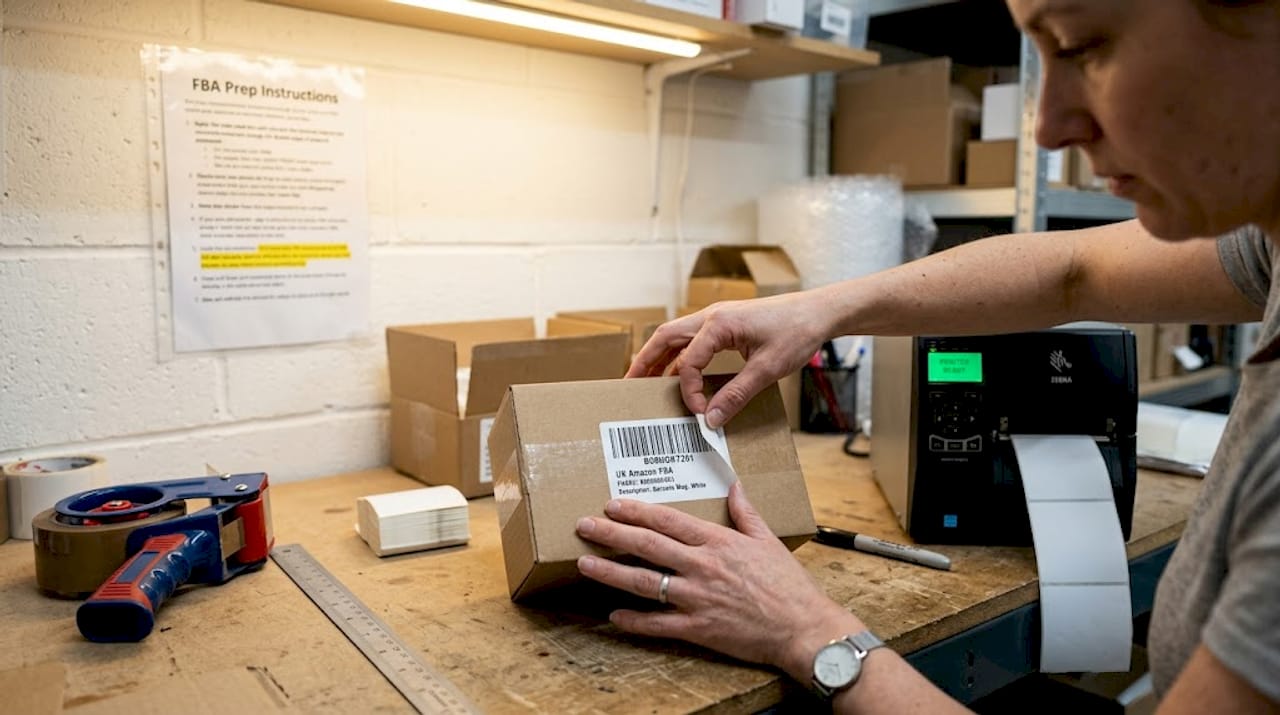
Poly bag requirements are equally strict. Any product placed in a poly bag must use material that is at least 1.5 mil thick. If the bag opening is 5 inches or larger, a suffocation warning must be printed or affixed visibly on the outside. This applies to clothing, soft goods, and any item that could be damaged by dust or moisture. Skipping the suffocation warning is one of the most commonly cited reasons for unit-level rejection.
Fragile items must be individually bubble wrapped so that a drop test from a reasonable height would not result in breakage. Amazon’s standard is that no glass or breakable surface should be exposed. For bundled products, the entire bundle must be labelled “Sold as Set” or “Do Not Separate” so warehouse staff do not split units apart during receiving.
Here is a practical compliance checklist for UK sellers:
Confirm every unit has a correctly placed, correctly sized FNSKU label
Check all poly bags meet the 1.5 mil thickness requirement
Add suffocation warnings to any poly bag with an opening over 5 inches
Wrap fragile items individually in bubble wrap
Label all bundles clearly as sets
Weigh every carton and confirm it is under 23kg per carton
Confirm no single dimension exceeds 25 inches unless pre-approved as an oversize item
Apply “Team Lift” labels to any carton over 50 lbs (approximately 23kg)
For carton dimensions, FNSKU labels must be scannable and cartons must not exceed 50 lbs or 25 inches on any side. UK sellers should note that the 23 to 25kg range is the practical working limit, and erring on the side of 23kg is the safer approach when in doubt.
Pro Tip: Invest in a quality thermal label printer calibrated to produce crisp, scannable FNSKU labels. Poor print quality is a silent rejection risk that many sellers only discover after a shipment has already been turned away. Proper barcode compliance starts with the quality of your print, not just the placement.
Requirement | UK standard | Common mistake |
FNSKU label size | 1x2 inches, thermal printed | Using inkjet or wrong dimensions |
Poly bag thickness | Minimum 1.5 mil | Using thin household bags |
Carton weight limit | Max 23kg | Overloading to save on carton count |
Max carton dimension | 25 inches per side | Ignoring height when calculating |
Bundle labelling | “Sold as Set” visible | Forgetting label on multi-packs |
FBA readiness process: From shipment plan to delivery
Having established the packaging and labelling rules, it is worth stepping back to see the full process that carries your products from your supplier or warehouse all the way to Amazon’s fulfilment network. Understanding each stage helps you spot where errors typically creep in.
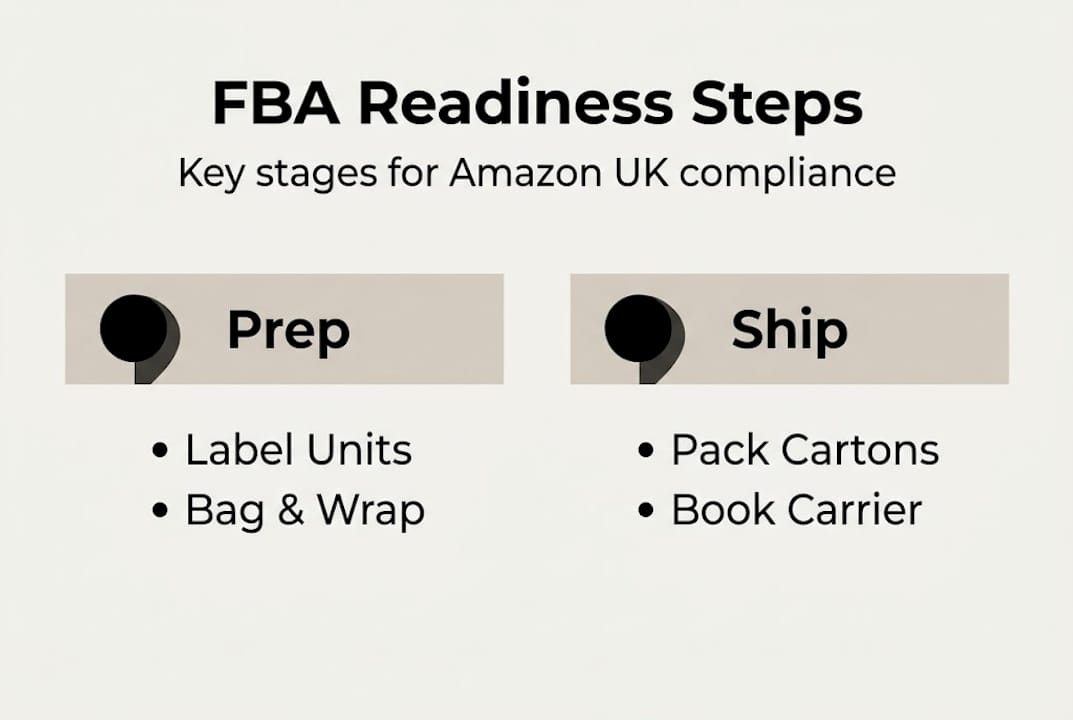
Step 1: Create your shipment plan in Seller Central UK. This is where you tell Amazon what products you are sending, in what quantities, and from which location. Your physical shipment must match this plan precisely. Discrepancies between the plan and the actual contents are a leading cause of check-in delays and receiving errors. Use the inventory preparation walkthrough to ensure your plan is set up correctly from the start.
Step 2: Prep your products. This is where all the labelling, poly bagging, bubble wrapping, and bundling happens. Whether you do this yourself or use a third-party logistics provider (3PL), every unit must be fully compliant before it goes into a carton.
Step 3: Pack and label your cartons. Each carton needs an Amazon shipment label on the outside, placed in a visible location. Carton contents must match what you declared in your shipment plan. Weigh and measure every carton before sealing it.
Step 4: Book your carrier and arrange collection. For smaller shipments, a standard parcel carrier works well. For larger volumes, LTL shipping for FBA offers a cost-effective route, but it requires palletising to Amazon’s specifications, including stretch wrapping and correct pallet labelling.
Step 5: Monitor check-in at the fulfilment centre. Once Amazon receives your shipment, they begin the check-in process. Use the shipment inspection checklist to pre-empt any discrepancies before they become problems.
Here is a direct comparison of prepping in-house versus using a 3PL:
Factor | In-house prep | 3PL prep centre |
Upfront cost | Lower | Per-unit fee applies |
Compliance risk | Higher (human error) | Lower (specialist staff) |
Scalability | Limited by your time | Scales with your volume |
Speed to Amazon | Dependent on your schedule | Faster with dedicated workflows |
2026 policy impact | Full responsibility on you | Shared expertise and accountability |
Since Amazon ended in-house prep corrections, using a 3PL is no longer just a convenience choice. For sellers scaling beyond a handful of SKUs, it is a practical necessity. A good prep centre catches errors before they reach Amazon, not after.
Common pitfalls during UK shipment execution include sending more units than declared in the shipment plan, using non-thermal labels that fade in transit, and failing to account for carton weight after adding dunnage (void fill). Each of these is avoidable with a solid pre-shipment checklist.
Common FBA readiness mistakes and how to avoid them
Once the end-to-end process is clear, it is worth focusing on where sellers most frequently go wrong. These mistakes are not rare edge cases. They are patterns we see repeatedly, and in 2026, the consequences are more severe than ever.
Ignoring policy updates is the most costly mistake. Amazon updates its prep requirements regularly, and sellers who set their processes once and never revisit them find themselves non-compliant without realising it. Since January 2026, Amazon ended in-house prep services, meaning there is no safety net. Audit your prep standards at least quarterly.
Overweight or oversized cartons are a persistent problem. Sellers often try to maximise carton efficiency by packing as much as possible into each box, inadvertently pushing cartons over the 23kg limit. Amazon’s receiving teams will flag these immediately, and the shipment may be refused or returned at your expense.
Barcode errors remain one of the top rejection triggers. This includes FNSKU labels placed over curved surfaces where the barcode distorts, labels printed at the wrong size, and manufacturer barcodes left uncovered. Review the FBA prep guide regularly to stay current on label specifications.
Insufficient pre-shipment audits mean that errors discovered at the fulfilment centre cannot be corrected in time. A simple internal audit, checking a random sample of units and cartons before despatch, catches the majority of compliance issues before they become expensive problems.
“Compliance is no longer just about avoiding rejection. In 2026, it is a competitive advantage. Sellers who consistently deliver clean, compliant shipments get faster check-in times, fewer inventory holds, and more reliable sales velocity.” This perspective aligns with what industry analysts have noted about zero-tolerance enforcement becoming the new normal.
Best practices for UK FBA sellers in 2026:
Schedule quarterly prep audits and update your SOPs after each Amazon policy change
Use a dedicated thermal printer for FNSKU labels and calibrate it monthly
Weigh every carton on a calibrated scale before sealing, not after
Partner with a 3PL for volume shipments to reduce your personal compliance burden
Keep a copy of your shipment plan accessible during packing to cross-reference quantities
Use fast FBA shipping tips to reduce time between prep completion and Amazon check-in
The sellers who treat compliance as a chore will keep stumbling. The sellers who build it into their operational rhythm will outperform them consistently.
Why real FBA readiness is the ultimate seller advantage in 2026
Most sellers think about FBA readiness defensively. They want to avoid rejection, avoid fees, and avoid the headache of a returned shipment. That framing is understandable but limiting.
Here is a different way to look at it. Every seller who cuts corners on prep is creating an opening for you. When their shipments get delayed or rejected, their inventory goes out of stock. Their listings lose rank. Their customers find alternatives. If your shipment arrives clean and compliant every single time, you do not just avoid problems. You actively gain ground.
Compliance is now a competitive advantage, not merely a baseline requirement. The sellers who recognised this shift early are already seeing faster check-in times and more consistent stock availability compared to those still treating prep as an afterthought.
Quarterly audits and expert 3PL support are not overhead costs. They are investments in operational reliability that pay back through fewer disruptions and faster Amazon seller services cycles. Process discipline, applied consistently, becomes part of your brand’s operational identity. That is not a soft benefit. It is a tangible edge in a marketplace where reliability directly drives revenue.
Get help with your FBA readiness today
If you are scaling your Amazon business and want to remove the compliance risk entirely, working with a specialist prep centre is the most direct route to consistent, stress-free FBA shipments. At Prep Horizon UK, we handle everything from receiving and inspection through to labelling, bundling, and shipment creation, so your inventory arrives at Amazon’s fulfilment centres correctly prepared, every time.

Whether you are sending your first shipment or managing hundreds of SKUs, our team ensures your products meet every requirement without you having to chase every policy update yourself. Clear communication, fast turnaround, and zero-tolerance for errors on our end means fewer problems on yours. Visit our affordable UK FBA prep page to see exactly what is included and get started today.
Frequently asked questions
What happens if my shipment is not FBA ready in 2026?
Amazon will reject non-compliant shipments, and they may be returned or destroyed at the seller’s expense. Since Amazon ended in-house prep corrections in January 2026, there is no on-site fix available.
What is the maximum carton weight for UK FBA shipments?
The UK maximum is 23kg per carton unless the box is marked “Team Lift”; exceeding this risks rejection at the fulfilment centre.
Do I need to add suffocation warnings to poly bags for FBA?
Yes, any poly bag opening over 5 inches must carry a visible suffocation warning, and the bag itself must be at least 1.5 mil thick.
Can Amazon prep my shipments for me?
No. As of January 2026, Amazon has ended in-house prep services for both the UK and US markets, meaning sellers must use their own processes or an external 3PL.
Recommended
Comments