
FBA fulfilment explained: boost your prep efficiency
Many UK Amazon sellers treat FBA prep and fulfilment as two completely separate operations, but this thinking causes real problems. When your receiving process is disconnected from your labelling workflow, or your inspection steps don’t feed directly into shipment creation, errors multiply and timelines slip. Fulfilment is not simply what happens after prep — it is woven through every stage of it. This article clarifies what fulfilment actually means in an FBA prep context, shows you exactly where it differs from standard prep tasks, and gives you practical, actionable steps to run tighter, faster, and more compliant operations as a UK Amazon seller.
Table of Contents
Key Takeaways
Point | Details |
Fulfilment defined | Fulfilment covers receiving, inspection, labelling, and shipment creation for FBA prep. |
Prep vs fulfilment | Understanding where prep ends and fulfilment begins helps prevent errors and delays. |
Efficiency impacts | Effective fulfilment practices reduce errors, speed up shipments, and ensure FBA compliance. |
Best practice integration | UK Amazon sellers should make fulfilment checks central to their everyday FBA prep routines. |
What is fulfilment in Amazon FBA prep?
Fulfilment is one of those terms that gets thrown around loosely in Amazon seller communities, and the vagueness causes genuine confusion. In the context of FBA prep, fulfilment refers to the end-to-end process of handling your products from the moment they arrive at a prep facility to the moment a completed, compliant shipment leaves for an Amazon fulfilment centre. It is not a single step. It is a coordinated sequence of activities, each one dependent on the last.
According to Prep Horizon UK, fulfilment includes receiving, inspection, labelling and shipment creation. These four components are the pillars of the process, and understanding each one individually helps sellers see the full picture.
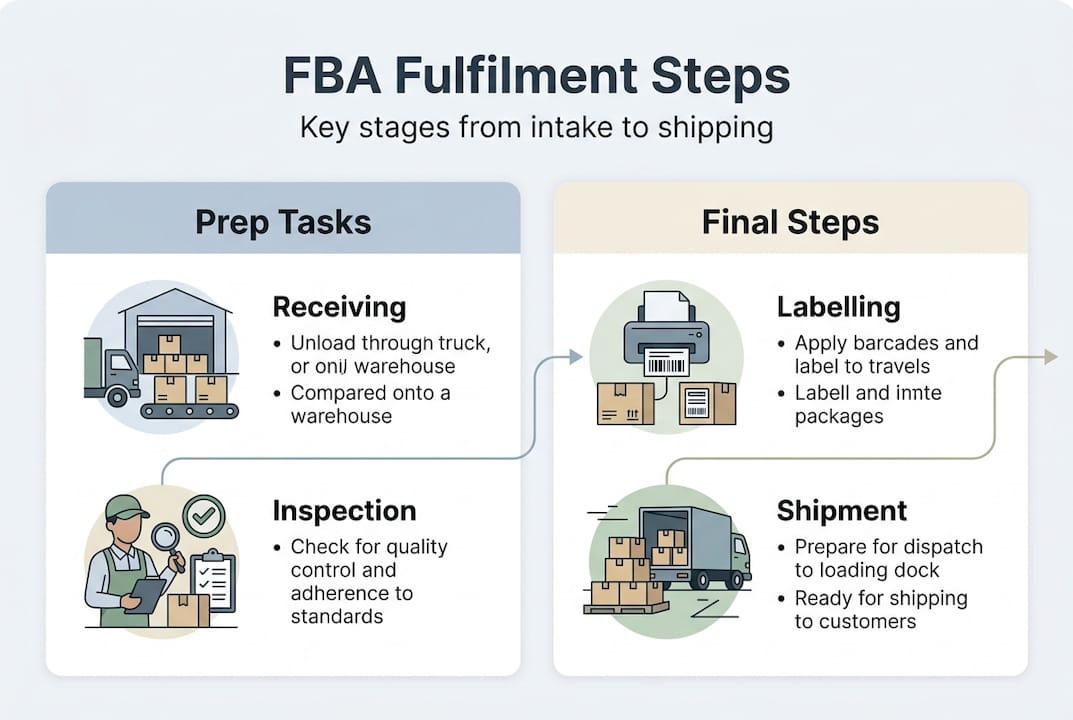
Receiving is the intake stage. Your goods arrive at the prep centre and are logged, counted, and matched against your purchase order or supplier manifest. This step catches discrepancies immediately, before any prep work begins. A short count at receiving is far cheaper to resolve at this point than after labelling has been completed.
Inspection follows. This is where products are checked for damage, incorrect variants, missing components, or any issues that would cause Amazon to reject the item at their fulfilment centre. Inspection is often skipped or rushed by sellers who manage their own prep, which creates costly problems downstream.
Labelling is perhaps the most visible step. Every unit must carry a scannable FNSKU barcode label applied precisely over any existing retail barcodes. Label placement, readability, and accuracy are all Amazon requirements, not suggestions. A misplaced label or a label printed at the wrong resolution can result in a receiving error at the fulfilment centre.
Shipment creation is the administrative and physical closing step. This involves building the shipment plan in Seller Central, packing units into correctly dimensioned boxes, printing and applying box labels, and arranging carrier collection or drop-off.
To better understand how these stages connect when you prepare inventory for FBA, consider the workflow as a chain where every link matters equally:
Receiving confirms what you actually have
Inspection confirms what is sellable
Labelling confirms each unit is identifiable by Amazon
Shipment creation confirms the consignment is ready to travel
Fulfilment is often misunderstood because sellers conflate it with logistics in the broader sense, or assume it only refers to post-sale delivery to the customer. In FBA prep, it means something far more specific: the structured movement of your inventory through a prep facility so that Amazon accepts it cleanly, first time.
Comparing FBA prep vs. fulfilment: What’s the real difference?
Now that you have a solid definition, it is worth separating the concepts clearly, because they are related but not identical. FBA prep refers to the physical tasks performed on your products: applying labels, poly-bagging, bubble-wrapping, creating bundles, adding suffocation warnings, and similar work. Fulfilment refers to the broader operational framework that contains those prep tasks and ensures they happen in the right order, at the right quality level, and in line with Amazon’s requirements.
Think of it this way. Prep is the what. Fulfilment is the how and when.
Function | FBA prep | Fulfilment |
Labelling units | Yes | Oversees quality and compliance |
Poly-bagging and wrapping | Yes | Ensures it meets Amazon spec |
Inventory receiving | No | Yes, intake and count |
Damage inspection | No | Yes, unit-level checks |
Shipment plan creation | No | Yes, Seller Central management |
Box labelling and dispatch | No | Yes, carrier coordination |
Bundling products | Yes | Oversees bundle integrity |
As a UK prep centre, Prep Horizon UK operates as a logistics hub managing FBA prep and fulfilment for sellers, bridging both sides of the equation under one roof. This is precisely where many sellers who self-manage their prep run into trouble. They focus on the physical prep tasks while ignoring the fulfilment framework around those tasks, and the workflow falls apart.
Here is how the split of responsibilities typically looks in practice:
A seller sources products from a supplier in the UK or overseas
The products arrive at the prep centre, where fulfilment begins with receiving
The prep centre inspects each unit against the seller’s requirements and Amazon’s standards
Physical prep tasks are carried out: labelling, bagging, bundling as required
The prep centre creates the shipment plan in Seller Central on the seller’s behalf or in coordination with the seller
Boxes are packed, weighed, and labelled for the correct Amazon fulfilment centre
The shipment is collected or booked in for drop-off
Understanding where your responsibilities end and where the prep centre’s begin is crucial for UK sellers who want to scale. When you check the detailed FBA prep requirements, you will quickly see that fulfilment touches far more touchpoints than most sellers initially expect.
The critical insight is this: outsourcing prep without understanding fulfilment means you cannot evaluate whether your prep centre is doing a good job. You need to know what should be happening at each stage to hold your partner accountable.
The impact of fulfilment on efficiency and compliance
Efficient fulfilment is not just about speed. It directly determines whether your products are accepted by Amazon, how quickly they become available for sale, and whether your seller account maintains its health metrics. Poor fulfilment creates a cascade of problems that are expensive to fix.

Error-free receiving, labelling and shipment creation prevent costly FBA rejections that delay your inventory and damage your cash flow. The numbers behind this are significant for growing sellers. Consider how each stage of fulfilment affects your broader operation:
Fulfilment stage | Common error | Impact on seller |
Receiving | Short count not caught | Overpaying for units not received |
Inspection | Damaged units not removed | FBA returns and negative feedback |
Labelling | Incorrect FNSKU applied | Amazon receiving errors and delays |
Shipment creation | Wrong dimensions entered | Carrier surcharges and rejected boxes |
Compliance is another dimension entirely. Amazon operates strict guidelines around how shipments must be constructed. A good shipment inspection checklist covers everything from box weight limits and pallet specifications to label placement and poly-bag thickness requirements. Failing any of these checks results in non-compliance fees charged directly to your seller account, or worse, a refused shipment.
“The most expensive mistake a UK FBA seller makes is skipping inspection because it feels like an optional extra. It is not optional. It is the filter that prevents everything else from going wrong.”
Labelling accuracy deserves particular attention. Amazon’s scanners operate at speed, and any label that cannot be read cleanly creates a problem. This includes labels that are wrinkled, partially covered, printed too light, or placed over curves or edges. A professional fulfilment process applies labels consistently to every unit because consistency is built into the workflow, not left to chance.
Pro Tip: Before partnering with any UK prep centre, ask specifically how they handle labelling failures. Do they have a re-labelling protocol? Do they charge extra, or is it included? The answer tells you a great deal about the quality of their fulfilment process. You can also compare affordable FBA prep options to ensure the price reflects genuine quality, not just low cost.
Good fulfilment also reduces your workload significantly. When receiving, inspection, labelling, and shipment creation all operate in sequence without bottlenecks, your inventory moves from supplier to Amazon faster. That speed has a direct impact on your sell-through rate and your ability to reorder before you run out of stock.
Best practices for UK Amazon sellers: Fulfilment-centred FBA prep
Knowing what fulfilment involves is only useful if you apply it. Here are the practical steps UK sellers should take to build a fulfilment-first approach into their FBA prep operations.
Start with a clear receiving protocol. Every shipment from your supplier should arrive with a purchase order that your prep centre can match against. Specify whether you want photo evidence of receiving, how discrepancies should be reported, and within what timeframe. Do not assume your prep centre will automatically notify you of a short count without a written process in place.
Mandate inspection for every batch, not just new products. Sellers often inspect their first order from a new supplier and then skip it once trust is established. This is a mistake. Quality can shift batch to batch, and catching a bad batch at inspection saves you from a flood of customer complaints after your products go live on Amazon.
Standardise your labelling instructions. Provide your prep centre with a clear document that specifies the FNSKU for each ASIN, label placement rules, and any product-specific requirements. If your products require bagging before labelling, say so explicitly. Ambiguity in labelling instructions is one of the top causes of prep errors.
Involve your prep centre in shipment creation. Some sellers handle Seller Central themselves and then send box labels to the prep centre. Others grant limited access to allow the prep centre to build shipment plans directly. The second approach is faster and reduces errors caused by miscommunication about box dimensions or unit quantities.
Prep centres help streamline FBA prep processes by offering logistics expertise that most individual sellers simply do not have in-house. The best FBA prep services are not just hands that apply labels. They are operational partners who understand how fulfilment decisions affect your Amazon account health.
Pro Tip: Integrate fulfilment checks at the beginning of your relationship with a prep centre, not after something goes wrong. Run a small test batch, review the process at each stage, and establish your communication expectations before sending high-value inventory.
Here is a practical checklist you can use when evaluating or working with any UK prep centre:
Receiving: are unit counts confirmed with documentation?
Inspection: are damaged or non-compliant units quarantined and reported?
Labelling: are FNSKU labels applied according to Amazon’s placement guidelines?
Bundling: are multi-unit bundles secured, labelled, and packaged to spec?
Shipment creation: are box weights, dimensions, and unit quantities accurately entered?
Dispatch: is carrier collection booked and tracking shared promptly?
Sellers who accelerate Amazon sales consistently are those who treat fulfilment as a strategic priority, not an afterthought.
Why most UK sellers underestimate fulfilment’s importance
Here is the uncomfortable truth. Most UK Amazon sellers only think about fulfilment when something has gone wrong. A rejected shipment, a labelling error, a unit count discrepancy — these are the events that force sellers to pay attention to processes they had previously ignored. By then, the cost has already been paid.
The conventional wisdom in FBA communities tends to focus heavily on product research, sourcing, and marketing. Fulfilment gets treated as a background process, something that just happens. But this attitude costs sellers money every single month in avoidable errors, delays, and compliance fees.
Logistics companies bridge the gap between FBA prep and fulfilment, and the sellers who lean into that expertise early are the ones who scale without operational chaos. The transformative shift happens when a seller stops thinking about fulfilment as a cost and starts seeing it as the foundation their entire operation rests on. A well-run FBA inventory prep process gives you predictability, and predictability is what allows you to grow with confidence. Stop waiting for something to break before you take fulfilment seriously.
Explore trusted fulfilment-backed FBA prep solutions
If this article has helped you see fulfilment differently, the next step is working with a prep centre that takes it just as seriously as you do.

At Prep Horizon UK, we handle receiving, inspection, labelling, bundling, and shipment creation for UK Amazon sellers who want accurate, compliant, fast-turnaround prep. Every stage of our process is designed around fulfilment best practices, so your inventory moves from us to Amazon’s fulfilment centres without the errors that drain your time and money. Whether you are just starting out or scaling an established catalogue, you can review our affordable prep services and find a solution that fits your operation. We are here to make FBA prep genuinely stress-free.
Frequently asked questions
What tasks are included in fulfilment for FBA prep?
Fulfilment in FBA prep covers receiving, inspection, labelling, and shipment creation, forming the end-to-end process that ensures your products reach Amazon’s fulfilment centres in a compliant, sellable state.
How does fulfilment affect my Amazon FBA seller performance?
Efficient fulfilment reduces labelling and shipment errors, which means fewer rejections and faster inventory availability. Error-free labelling and shipment creation directly protects your seller metrics and account health.
Can I outsource fulfilment to a prep centre in the UK?
Yes. UK prep centres act as logistics hubs managing FBA prep and fulfilment together, handling every stage from intake to dispatch so you can focus on sourcing and growing your business.
What is the difference between FBA prep and fulfilment?
FBA prep refers to the physical tasks performed on your products, such as labelling and bagging, while fulfilment is the broader operational framework that coordinates receiving, inspection, and shipment creation around those prep tasks.
Recommended
Comments