
Fast shipping FBA explained: accelerate your Amazon sales

Fast shipping on Amazon is not simply about how quickly a parcel leaves a warehouse. It starts much earlier, with how you prepare your inventory, route your shipments, and meet Amazon’s compliance standards. FBA enables 1-2 day delivery by handling pick, pack, and dispatch from its own fulfilment centres, but sellers who skip corners on prep often find their stock sitting in check-in queues for days. This guide breaks down every stage of the fast FBA shipping process so UK sellers can earn the Prime badge, avoid costly delays, and give customers the rapid delivery experience that drives repeat purchases.
Table of Contents
Key Takeaways
Point | Details |
Prime badge drives sales | Fast Shipping FBA makes your products eligible for Prime, increasing conversion rates and revenue. |
Inbound shipping is crucial | Efficient, compliant inbound shipping to FBA centres reduces delays and supports rapid delivery to customers. |
Compliance prevents delays | Labelling, packaging, and customs compliance safeguard your shipments against processing hold-ups. |
Alternatives offer control | Seller Fulfilled Prime and 3PL options allow more direct management but require superior performance and compliance. |
What is fast shipping FBA?
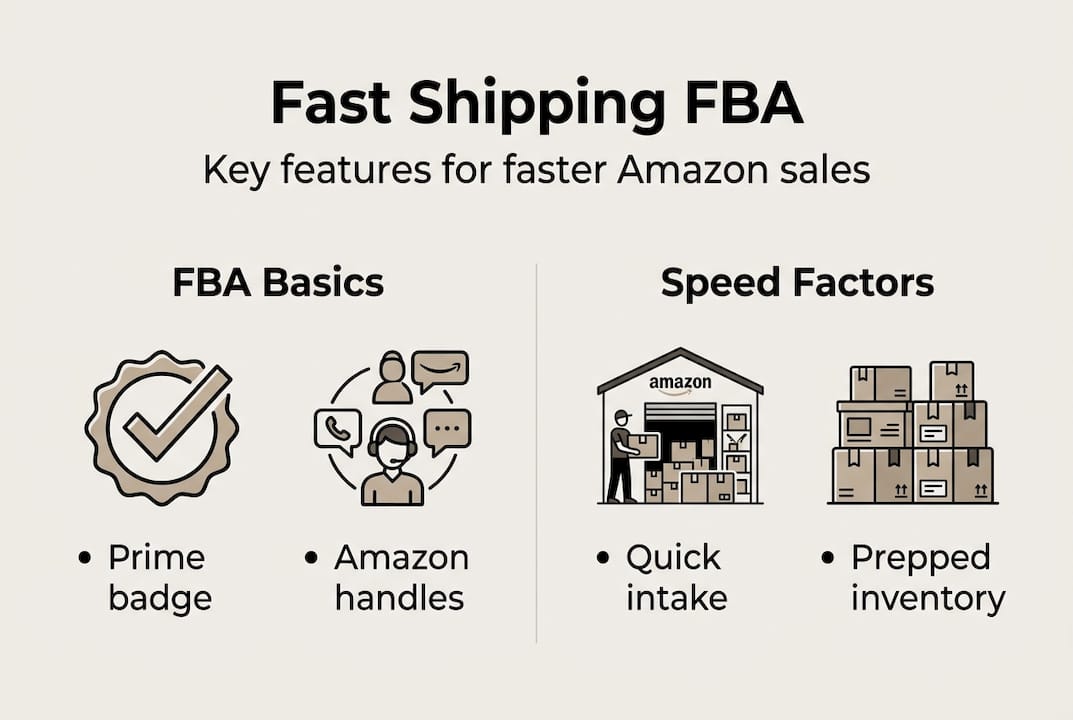
Fulfilment by Amazon (FBA) is a service where you send your inventory to Amazon’s fulfilment centres and Amazon takes over from there. Once stock is checked in, Amazon handles storage, picking, packing, and delivery. The result is that your listings become eligible for Prime, which means customers can expect one to two day delivery without you lifting a finger on dispatch day.
The Prime badge is not just a logo. It is a trust signal that influences buying decisions at scale. Shoppers actively filter search results by Prime eligibility, and listings without it are frequently overlooked regardless of price or reviews. Understanding the mechanics behind fast shipping FBA helps you protect that badge and keep your listings competitive.
Here is what fast shipping FBA actually involves for sellers:
Sending compliant inventory to Amazon fulfilment centres in the correct packaging and with accurate labels
Meeting Amazon’s inbound requirements so stock clears check-in quickly without being flagged or quarantined
Maintaining healthy account metrics to retain Prime eligibility across your catalogue
Routing shipments efficiently to minimise transit time and warehousing delays
The numbers back this up. Over 65% of UK sellers use FBA as their primary fulfilment method, and a pilot programme for faster merchant fulfilment showed a 34% sales lift when delivery was nine days faster. That figure alone illustrates how directly speed affects revenue.
For sellers new to the programme, understanding FBA prep requirements is the logical first step. Getting your inventory correctly prepared before it reaches the fulfilment centre is what separates sellers who enjoy smooth check-ins from those who face delays, rejections, and suspended listings. Similarly, correct FBA labelling is non-negotiable. A missing or incorrect barcode can send your shipment into a manual processing queue that adds days to your timeline.
Key steps for efficient FBA inbound shipping
Getting stock into Amazon’s fulfilment centres quickly and cleanly is where fast shipping FBA is won or lost. Many sellers focus entirely on the customer-facing side and neglect the inbound process. That is a costly oversight.
Follow these steps to optimise your inbound shipping:
Choose Amazon Partnered Carriers for your shipments wherever possible. These carriers have established relationships with Amazon’s receiving teams, which typically results in faster check-in and fewer discrepancies.
Pack boxes correctly. Boxes must not exceed 23kg and must be properly sealed with no bulging sides. Overpacked boxes are rejected at the dock.
Use UK-standard pallets measuring 1200x1000mm, constructed from heat-treated wood. This is a firm requirement for pallet shipments, and non-compliant pallets are turned away.
Keep pallets within height limits. The maximum pallet height including the pallet itself is 1.8 metres. Exceeding this causes immediate rejection.
Use the Send to Amazon list view in Seller Central to check real-time fulfilment centre capacity before confirming your shipment destination. This tool helps you route stock to centres with shorter check-in queues.
Efficient inbound shipping directly reduces check-in times and keeps your inventory available for sale faster. Amazon’s newer inbound tools make it easier to see where capacity is available, which is particularly valuable during peak periods like Q4.

Requirement | Standard | Consequence of non-compliance |
Box weight | Max 23kg | Rejection at receiving dock |
Pallet size | 1200x1000mm | Shipment turned away |
Pallet height | Max 1.8m | Immediate rejection |
Wood treatment | Heat-treated only | Customs or dock refusal |
Barcode labelling | FNSKU per unit | Manual processing delays |
Pro Tip: Book your inbound shipments mid-week when fulfilment centre intake volumes are typically lower. Avoiding Monday and Friday drops can shave one to two days off your check-in time.
For sellers managing complex shipments, reviewing shipping coordination tips can prevent common errors before they happen. Equally, brushing up on barcode labelling rules and running through an inspection checklist before dispatch catches issues that would otherwise cause expensive delays. For pallet-specific guidance, the pallet shipping standards resource covers UK requirements in full detail.
Compliance, inventory prep, and customs
Compliance is not a box-ticking exercise. It is the mechanism that keeps your inventory moving through Amazon’s system without interruption. When a shipment fails compliance checks, it does not simply get corrected and moved on. It enters a manual review process that can take days or even weeks to resolve.
For UK sellers, the post-Brexit landscape adds an additional layer of complexity. Customs documentation must be accurate and complete, VAT registration must be current, and import paperwork must match your shipment contents precisely. A single discrepancy can freeze your stock at the border before it even reaches the fulfilment centre.
Here is what UK sellers must get right:
VAT registration and accurate invoicing on all imported goods to avoid customs holds
Correct FNSKU labelling on every unit before it arrives at the fulfilment centre
Proper product categorisation to ensure your goods clear customs under the right commodity codes
Bundling and packaging compliance so multi-unit products are correctly identified and will not be separated during receiving
Prioritising compliance and optimal inbound routing is especially important during peak periods when fulfilment centres are processing higher volumes and have less tolerance for non-compliant shipments.
Pro Tip: Outsourcing your prep to a specialist UK prep centre means your inventory arrives at the fulfilment centre already compliant. This removes the risk of human error in labelling, bundling, and documentation, and typically results in faster check-in times.
Reviewing inventory preparation tips gives you a structured framework for getting stock ready before it leaves your hands. Pairing this with solid barcode compliance practices ensures your shipments clear Amazon’s receiving process without unnecessary friction.
Alternatives to FBA: Seller Fulfilled Prime (SFP) and third-party logistics (3PL)
FBA is not the only route to Prime eligibility. Seller Fulfilled Prime (SFP) allows you to display the Prime badge on your listings while fulfilling orders yourself. The trade-off is significant: you must maintain a 99% or higher on-time delivery rate, offer weekend shipping, and consistently meet Amazon’s performance thresholds. Miss those targets and you lose the badge.
SFP suits sellers with strong logistics infrastructure and tight control over their fulfilment operations. For most small to mid-sized UK sellers, maintaining those standards independently is genuinely difficult.
Third-party logistics providers (3PLs) offer a middle ground. Rather than sending stock directly to Amazon, you route it through a 3PL first. The 3PL handles prep, compliance checks, and onward shipping to the fulfilment centre. Inbound delays average over 10 days when shipping direct without proper preparation, but a well-run 3PL can cut that significantly.
Method | Prime eligibility | Control level | Compliance burden | Best for |
FBA | Automatic | Low | Amazon-managed | Most UK sellers |
SFP | Conditional | High | Seller-managed | Established operations |
3PL + FBA | Automatic | Medium | Shared | Growing sellers |
“SFP gives you the Prime badge and full control over fulfilment, but the performance requirements leave very little room for error. One bad week can cost you the badge entirely.”
Key considerations when choosing between these options:
Volume and scalability: FBA scales automatically; SFP requires you to scale your own logistics
Cost structure: FBA fees are predictable; SFP costs depend on your carrier agreements
Compliance risk: FBA offloads compliance to Amazon; SFP and 3PL keep it with you
For sellers exploring 3PL shipping coordination or weighing up a prep centre versus in-house warehousing, the decision ultimately comes down to where your time and risk tolerance sit.
Why most UK Amazon sellers underestimate fast shipping FBA
Here is the uncomfortable truth: most sellers think fast shipping is a dispatch problem. They obsess over same-day cut-off times and carrier selection, while their real bottleneck sits weeks earlier in the process, buried in inbound check-in queues and compliance failures.
We see this pattern regularly. A seller invests in great products, competitive pricing, and strong listings, then watches their stock sit in a fulfilment centre’s receiving queue for ten days or more because a label was wrong or a pallet was the wrong size. Inbound delays averaging over 10 days are not unusual when sellers manage prep in-house without a structured process.
The fix is not complicated, but it does require a shift in thinking. Fast shipping FBA is an end-to-end process that starts the moment you order stock. Compliance, labelling, customs documentation, and inbound routing all feed into how quickly your inventory becomes available for sale. Getting those elements right consistently is what separates sellers who maintain Prime eligibility year-round from those who lose it during their busiest trading periods.
Professional prep through a UK-based prep centre converts that uncertainty into a reliable, repeatable process. What takes an in-house team days of error-prone manual work can be turned around in a fraction of the time by specialists who do nothing else.
Streamline your FBA shipping with Prep Horizon UK
If this guide has highlighted gaps in your current FBA process, the good news is that fixing them does not have to fall entirely on your shoulders.

As a trusted FBA prep centre based in the UK, Prep Horizon UK handles receiving, inspection, labelling, bundling, and shipment creation so your stock arrives at Amazon’s fulfilment centres compliantly and quickly. We work with sellers at every stage, from first shipments to high-volume operations, and our clear communication means you always know where your inventory stands. Whether you need help with customs paperwork, FNSKU labelling, or full prep management, explore our FBA prep pricing and find a solution that fits your business.
Frequently asked questions
How does fast shipping FBA improve my sales?
FBA fast shipping can lift sales by up to 34% through Prime eligibility and faster delivery, which directly increases conversion rates and repeat purchases.
What packaging requirements must UK sellers follow for FBA?
Boxes must not exceed 23kg, pallets must meet UK-standard sizing of 1200x1000mm using heat-treated wood, and all units must carry correct FNSKU labels to avoid processing delays.
How can I speed up inbound shipping to Amazon fulfilment centres?
Use Amazon Partnered Carriers and the Send to Amazon list view to select fulfilment centres with available capacity, and consider outsourcing prep to reduce check-in processing times significantly.
What are the benefits of Seller Fulfilled Prime compared to FBA?
SFP offers Prime badge eligibility and greater fulfilment control, but requires a 99% on-time delivery rate and weekend shipping, making it demanding to sustain without robust logistics infrastructure.
Recommended
Comments