
Demystifying Amazon FBA fees to maximise UK profits

Amazon can consume 30 to 50% of your selling price including VAT once you add up referral fees, fulfilment charges, storage costs, and the various optional extras that quietly stack up on your Seller Central account. Most UK FBA sellers know fees exist, but very few have a complete picture of exactly how each charge is calculated, when it escalates, and what happens when slow-moving stock sits in an Amazon warehouse longer than expected. This guide breaks down every significant fee category, explains the mechanics behind the numbers, and gives you practical strategies to protect your margin in 2026 and beyond.
Table of Contents
Key Takeaways
Point | Details |
Know major fee types | Referral, fulfilment, storage, and optional fees each impact your seller margin in unique ways. |
Watch for surcharges | Aged inventory and high storage utilisation can quietly increase costs if not monitored regularly. |
Optimise packaging | Dimensional weight can inflate fulfilment fees, so streamline your packaging wherever possible. |
Leverage Low-Price FBA | Items under £20 benefit from special fee reductions starting in February 2026. |
Quality and inventory management matter | Keeping return rates low and managing inventory efficiently will help avoid hidden fees and preserve profit. |
Types of Amazon FBA fees for UK sellers
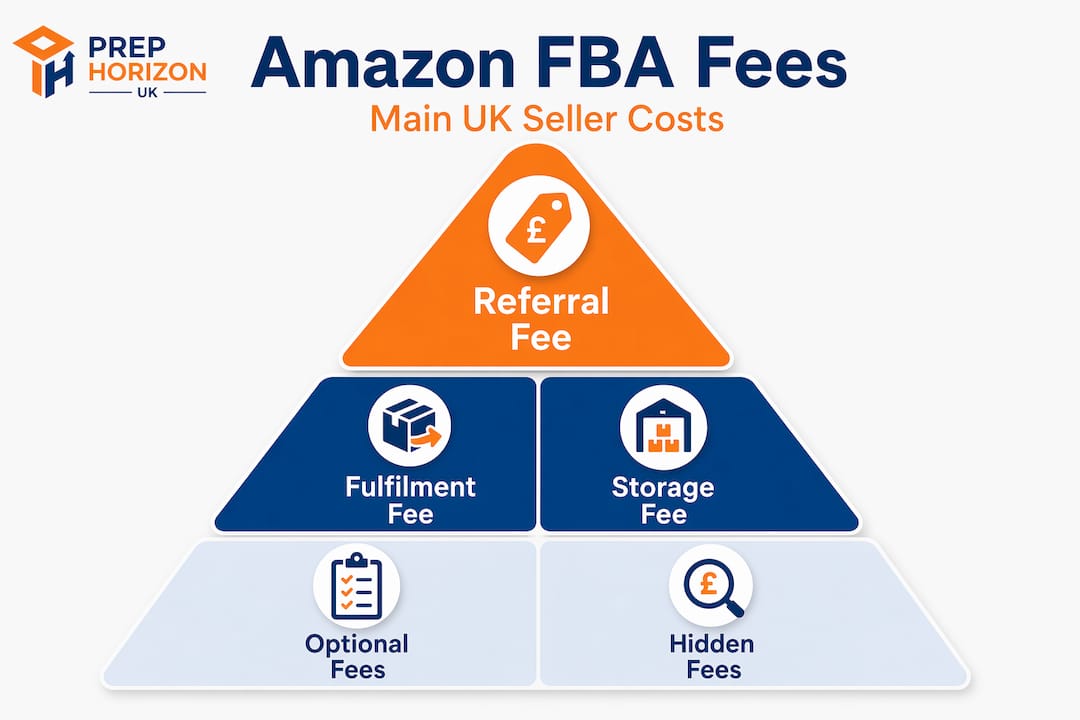
Understanding the full landscape of Amazon marketplace fees is the essential first step before you can begin optimising anything. There are four primary categories every UK seller needs to account for, and each one behaves differently depending on your product, category, and selling strategy.
Referral fees are the percentage Amazon charges on every sale. These typically sit between 8% and 15.3% of the selling price and vary by category. Electronics tend to attract lower referral fees, while jewellery and accessories sit at the higher end. From 2026, certain categories including clothing, home goods, pet products, and grocery benefit from reduced referral rates of 5 to 10% for lower-priced items, which is genuinely good news for sellers in those spaces.
FBA fulfilment fees cover picking, packing, and shipping your products to customers. These range from approximately £2.50 to £12 per unit, depending on size and weight tiers. Amazon reduced fulfilment fees by an average of £0.26 per unit for standard parcels from December 2025, and the new Low-Price FBA programme for items priced at £20 or below saves sellers an average of £0.45 per unit from February 2026.
Monthly storage fees are charged per cubic foot of space your inventory occupies in Amazon’s fulfilment centres. Off-peak rates from January to September sit around £0.76 per cubic foot, while October to December sees higher charges to reflect peak demand on warehouse capacity.
Optional and hidden fees include returns processing, removal orders, disposal requests, and various surcharges that many sellers only discover when they appear on their account statements. Understanding different types of seller services helps you anticipate which of these extras might apply to your specific operation.
Fee type | Typical range | Key variables |
Referral fee | 8% to 15.3% | Product category, selling price |
FBA fulfilment fee | £2.50 to £12+ per unit | Size tier, dimensional weight |
Monthly storage (off-peak) | £0.76/ft³ | Inventory volume, time of year |
Monthly storage (peak Q4) | Higher rate | Oct to Dec surcharge |
Aged inventory surcharge | £1.18 to £5.71/ft³ | Days in storage (241 days+) |
Returns processing | ~£0.12+ per unit | Category return rate thresholds |
Removal/disposal | Variable | Per unit, order size |
The combined effect of these categories is why sellers who only focus on the referral fee frequently underestimate their true cost of selling. Running the numbers properly requires accounting for all four categories simultaneously.
How fulfilment and storage fees impact your profit
Now that you know the categories, it is crucial to examine which fees hit hardest and how they behave throughout the year. The mechanics of fulfilment and storage fees are more complex than they first appear, and small misunderstandings here can lead to significant unexpected costs.

Fulfilment fees are calculated using the greater of actual or dimensional weight, where dimensional weight equals the product’s volume in cubic centimetres divided by 5,000. A small but lightweight item in a large box can therefore attract a much higher fee than its actual weight would suggest. Small parcels weighing up to 3kg typically attract fees between roughly £3.50 and £4.80, while standard parcels up to 11.9kg attract fees up to approximately £3.58 with recent reductions. Oversized items attract fees starting from £8 and rising considerably from there.
The single most important thing to understand about estimating FBA costs is that your packaging choices directly influence which size tier you fall into. A product that measures just a few millimetres over a tier boundary can cost you an extra pound per unit in fulfilment fees, which adds up fast across thousands of units.
“Aged inventory surcharges apply from 241 days storage (updated from the previous 271-day threshold in February 2026): charges range from £1.18/ft³ for inventory stored 241 to 270 days, rising to £5.71/ft³ for items stored 365 days or more, on top of regular monthly storage fees. A storage utilisation surcharge also applies when your inventory-to-sales ratio is high, for instance exceeding 22 weeks of cover adds £0.42/ft³ or more.” — FBA storage fee calculator
The seasonal escalation in Q4 is another critical factor. Storage fees increase meaningfully from October through December, precisely when many sellers are sending in their highest volumes of stock. Sending in too much inventory too early for peak season means paying elevated storage rates on units that have not yet sold.
Aged inventory surcharges are arguably the most dangerous fee for sellers who carry slower-moving products. The threshold dropped from 271 days to 241 days in February 2026, meaning you have less time before penalties kick in. At the higher end, 365 plus days of storage can cost £5.71 per cubic foot in surcharges alone, and when combined with regular monthly storage fees, the total can easily exceed the value of the product itself.
Pro Tip: Use the inventory management tools available in Seller Central to monitor your aged inventory report weekly rather than monthly. By the time you catch an issue on a monthly review, you may already have crossed a fee threshold.
Storage duration | Aged inventory surcharge |
0 to 240 days | None |
241 to 270 days | £1.18/ft³ |
271 to 364 days | Escalating charges |
365 days and over | £5.71/ft³ |
Returns, removals and hidden charges: What most sellers overlook
Beyond routine fees lie several often ignored charges that can quietly undermine your profitability. Many sellers focus heavily on referral and fulfilment fees whilst completely overlooking the costs associated with returns, removals, and the growing range of penalty-style surcharges Amazon applies to certain behaviours.
Returns processing fees apply when your return rate in a given category exceeds Amazon’s defined threshold. For clothing, the typical threshold sits between 2 and 5%, and charges run at approximately £0.12 or more per returned unit. Critically, from 2025 into 2026, Amazon has been expanding these fees to additional categories including electronics, particularly where defect or damage rates are elevated. If you sell in a category with naturally higher return rates, you need to factor this in proactively rather than reactively.
Here is a practical breakdown of the hidden and optional fees most sellers underestimate:
Returns processing fees: Applied per returned unit once category return thresholds are exceeded, approximately £0.12 and rising
Removal order fees: Charged per unit when you request Amazon to return inventory to you, variable by size
Disposal fees: Lower cost than removal but the product is destroyed, a decision that requires a cost analysis
Storage utilisation surcharge: Applied when your inventory-to-sales cover exceeds thresholds, such as 22 weeks, adding £0.42/ft³ or more
Unplanned service fees: Charged when products arrive at fulfilment centres without correct labelling or preparation
FBA inbound placement fees: Charged when Amazon has to move your inventory across its network to meet demand
The edge cases around aged stock are where sellers can take the biggest unexpected hits. When inventory reaches the 365 plus day threshold, total fees per cubic foot (combining monthly storage with the aged surcharge) can easily exceed the wholesale cost of the product sitting in that space. Removing inventory proactively before it crosses the 241-day mark is almost always the better financial decision, even if it means eating a small removal order fee.
Pro Tip: Run a removal versus liquidation cost analysis for any inventory approaching 200 days in storage. Liquidation through Amazon’s programme recovers a small percentage of the product value rather than nothing at all, which often beats paying escalating surcharges and then disposing of the product anyway.
Real-world data from seller forum discussions paints a stark picture. Solo sellers managing 20 to 200 SKUs risk between £30,000 and £45,000 in annual stockout losses, and aged storage costs can exceed £500 per month for sellers with slow-moving product lines. These are not edge-case figures, they are routine outcomes for sellers who do not actively monitor their inventory metrics. Handling FBA returns effectively requires a clear system, not a reactive scramble.
Actionable tips to reduce Amazon FBA fees
Armed with the fee breakdown and risk insights, let us focus on practical steps to cut costs. These strategies come from experienced sellers and FBA experts who have tested them against real account data.
Optimise your packaging dimensions. Measure your product in its shipping packaging before sending stock to Amazon and verify which size tier it falls into. Reducing box dimensions by even a small amount can shift you to a lower tier and save a meaningful amount per unit at scale.
Leverage Low-Price FBA for items under £20. The Low-Price FBA expansion from February 2026 saves an average of £0.45 per unit. If you sell fast-moving, lower-cost items, this programme can have a material impact on your margin across a full year of sales volume.
Keep return rates below category thresholds. Invest in detailed product listings with accurate sizing information, clear photographs, and honest descriptions. The cost of a returns processing fee frequently exceeds the margin on the item itself, so prevention is dramatically cheaper than the fee.
Create a 90-day inventory review cycle. Set calendar reminders to review stock levels every 90 days and flag any SKU that is tracking towards the 241-day threshold. Act at 180 days rather than waiting until you are close to the boundary.
Use dimensional weight calculations before buying packaging. Apply the volume divided by 5,000 formula to every new product or packaging change before you commit to a design. FBA packaging compliance affects both your fee tier and your ability to pass Amazon’s receiving checks.
Monitor your storage utilisation ratio. If your inventory-to-sales cover is creeping above 22 weeks for any SKU, consider running a promotional price reduction to clear stock before the utilisation surcharge applies. A 10% price cut to shift inventory is almost always cheaper than the surcharge over several months.
Use prep cost-saving strategies before inventory enters Amazon’s network. Getting your prep right before stock reaches a fulfilment centre avoids unplanned service fees, which Amazon charges for fixing issues they identify at inbound receipt.
Pro Tip: Cross-reference the FBA fee calculator against your actual Seller Central statements each month. Discrepancies between expected and actual fees are not uncommon, and Amazon does correct overcharges if you raise them through the reimbursement process.
Why fee clarity matters more than chasing savings
Here is a perspective worth sitting with: most sellers approach FBA fees as a cost-reduction exercise, looking for the single biggest charge to chip away at. That framing misses something important. The real damage to margins typically comes not from the largest visible fee but from the accumulation of smaller charges that nobody is actively watching.
The expert tips that genuinely move the needle tend to focus on visibility first and optimisation second. A seller who knows exactly what every line item on their FBA statement means, and why it changed compared to last month, is in a fundamentally stronger position than a seller who has negotiated a slightly better packaging spec but has no idea what their storage utilisation ratio is doing.
Fee structures change. Amazon updated aged inventory thresholds, expanded Low-Price FBA, adjusted fulfilment rates, and broadened returns processing categories all within the span of a few months across late 2025 and early 2026. The sellers who caught each of those changes early adapted their inventory and pricing strategies in time. The sellers who found out months later absorbed the costs retroactively.
Holistic fee understanding means treating your FBA cost structure as a living system, not a fixed overhead to be calculated once per product launch. The sellers we work with who achieve the best margins are not necessarily the ones with the leanest packaging. They are the ones who review their fee reports consistently, understand what drives each charge, and make proactive decisions before costs escalate.
Optimise your FBA fees with professional support
Getting to grips with Amazon’s fee structure is genuinely complex, and even experienced sellers find it difficult to stay on top of every update while also running their business.

At Prep Horizon, we work with UK FBA sellers every day, handling receiving, inspection, labelling, bundling, and shipment creation with the kind of accuracy that prevents unplanned service fees before they happen. Our team keeps up with Amazon’s ever-changing compliance requirements so you do not have to worry about a shipment being rejected or products arriving without correct preparation. Visit our trusted UK FBA prep centre to learn more about how we support sellers at every stage, and explore our transparent affordable FBA prep pricing to see exactly what professional prep costs. When your prep is handled correctly the first time, you avoid a whole category of fees before they ever appear on your statement.
Frequently asked questions
How are Amazon FBA fulfilment fees calculated in the UK?
Fulfilment fees are calculated based on the greater of actual or dimensional weight, using the formula volume in cm³ divided by 5,000, with size tiers and parcel weights determining the final per-unit charge.
What triggers aged inventory surcharges on Amazon FBA?
Inventory stored for 241 days or more incurs aged inventory surcharges ranging from £1.18 to £5.71 per cubic foot, in addition to regular monthly storage fees, with the threshold tightened from 271 days in February 2026.
How do Low-Price FBA fees work for items under £20?
Low-Price FBA applies from February 2026 to items priced at £20 or below, saving sellers an average of £0.45 per unit compared to standard fulfilment fee rates.
Are return processing fees charged on all categories?
Return fees apply to high-return categories exceeding defined thresholds, currently including clothing and expanding to electronics and other categories in 2025 and 2026 where defect or return rates are elevated.
Recommended
Comments