
Amazon prep centre explained: the UK seller's guide
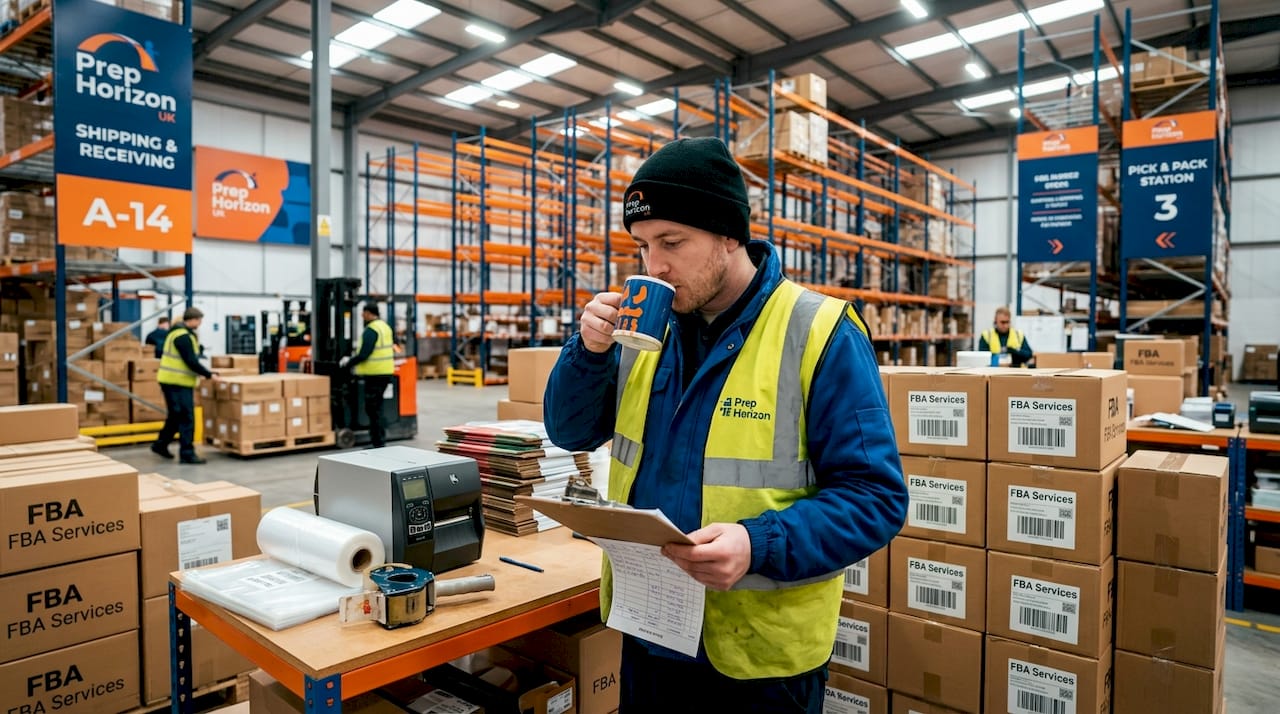
Many UK Amazon FBA sellers treat product prep as an afterthought, only to discover that a single mislabelled shipment can trigger rejection fees, delayed inventory, or worse, a suppressed listing. An amazon prep centre explained properly is not just a logistics concept but a practical tool that changes how you operate. This guide covers what prep centres do, what they charge, how fast they work, and how to choose one that fits your business. By the end, you will know exactly what to expect and how to avoid the costly mistakes that catch so many sellers off guard.
Table of Contents
What is an Amazon prep centre and what services do they provide?
How much do Amazon prep centres charge in the UK, and what affects pricing?
Operational timelines and capacity: what to expect from your prep centre
How to choose the best prep centre for your UK Amazon FBA business
Optimising your prep centre workflow for UK Amazon FBA success
Why relying on a professional prep centre is a strategic investment, not just a cost
What is an Amazon prep centre and what services do they provide?
An Amazon prep centre is a third-party warehouse that receives your products, processes them to meet Amazon’s FBA requirements, and sends them directly to an Amazon fulfilment centre on your behalf. You never need to touch the stock yourself.
Think of it as a specialist handler sitting between your supplier and Amazon. Your goods arrive at the prep centre, the team checks them, applies the correct labels, packages them appropriately, and builds the shipment according to Amazon’s rules. This is the core of what any amazon prep centre explainer needs to make clear: prep centres exist because Amazon’s inbound requirements are genuinely complex and unforgiving.
Prep-related compliance work typically includes quality inspection, FNSKU labelling, protective packaging, and full shipment preparation. Each of those steps has specific Amazon standards attached to it, and failing any one of them can lead to a rejected shipment or an unplanned prep fee charged by Amazon itself.
The key services most reputable UK prep centres offer include:
Quality inspection: Checking units for damage, incorrect quantities, or defects before they reach Amazon’s warehouse
FNSKU labelling: Applying the correct Amazon barcode to each unit so it is properly attributed to your seller account
Polybagging and suffocation warning labels: Required for soft goods, loose items, and anything that poses a suffocation risk
Bubble wrapping and fragile item protection: Prevents damage in transit and during Amazon’s inbound scanning process
Box preparation: Building cartons that meet Amazon’s strict size, weight, and labelling rules, including the required box labels on all four sides
Bundling and kitting: Grouping multiple units into a single ASIN package, often used for multipack listings or promotional sets
Each of these activities prevents the kind of compliance failures that result in shipment rejections and unexpected fees. Amazon is not lenient about prep errors, and the costs accumulate fast.
How much do Amazon prep centres charge in the UK, and what affects pricing?
Pricing is one of the first things sellers want to know, and rightly so. The honest answer is that costs vary depending on what your products need, how many units you are sending, and where your supplier is located.
Base prep fees commonly fall in the £0.40 to £1.50 per unit range, with additional charges for services like polybagging or bubble wrapping. FBA prep fees can reach £1.50 or more per unit for larger or more complex items. Here is a realistic breakdown of what UK sellers typically encounter:
Service | Typical cost per unit |
Basic prep and FNSKU labelling | £0.40 to £0.75 |
Polybagging with warning label | £0.20 to £0.40 additional |
Bubble wrap or fragile protection | £0.25 to £0.50 additional |
Bundling or kitting | £0.50 to £1.50 additional |
Oversized item handling | £1.50 to £3.00+ |
Several factors push costs up or down:
Volume: Most prep centres offer tiered pricing. Sending 500 units per month costs noticeably more per unit than sending 2,000. Committing to higher volumes is often the single fastest way to reduce your per-unit cost.
Product complexity: A simple book needs a label. A fragile glass item needs a label, bubble wrap, and possibly a warning sticker. Complexity drives time, and time drives cost.
Supplier location: If your goods arrive from China with mixed carton sizes or non-standard packaging, the prep centre will spend more time sorting and repackaging. That labour has a price.
Additional services: Photography, re-boxing, custom inserts, or returns processing are usually charged separately.
Pro Tip: Always ask for a full service menu with prices before committing. A lower headline rate can become expensive once optional services are added. Transparent prep centre pricing is one of the most reliable indicators of a trustworthy operation.
Understanding your true cost per unit, including all add-ons, is essential to reducing overall prep costs and protecting your margins as you scale.
Operational timelines and capacity: what to expect from your prep centre
Speed matters in FBA. Slow inventory means empty stock, which means lost sales and a damaged sales rank. Understanding Amazon prep logistics means understanding that turnaround time is not just a convenience issue. It directly affects your bottom line.
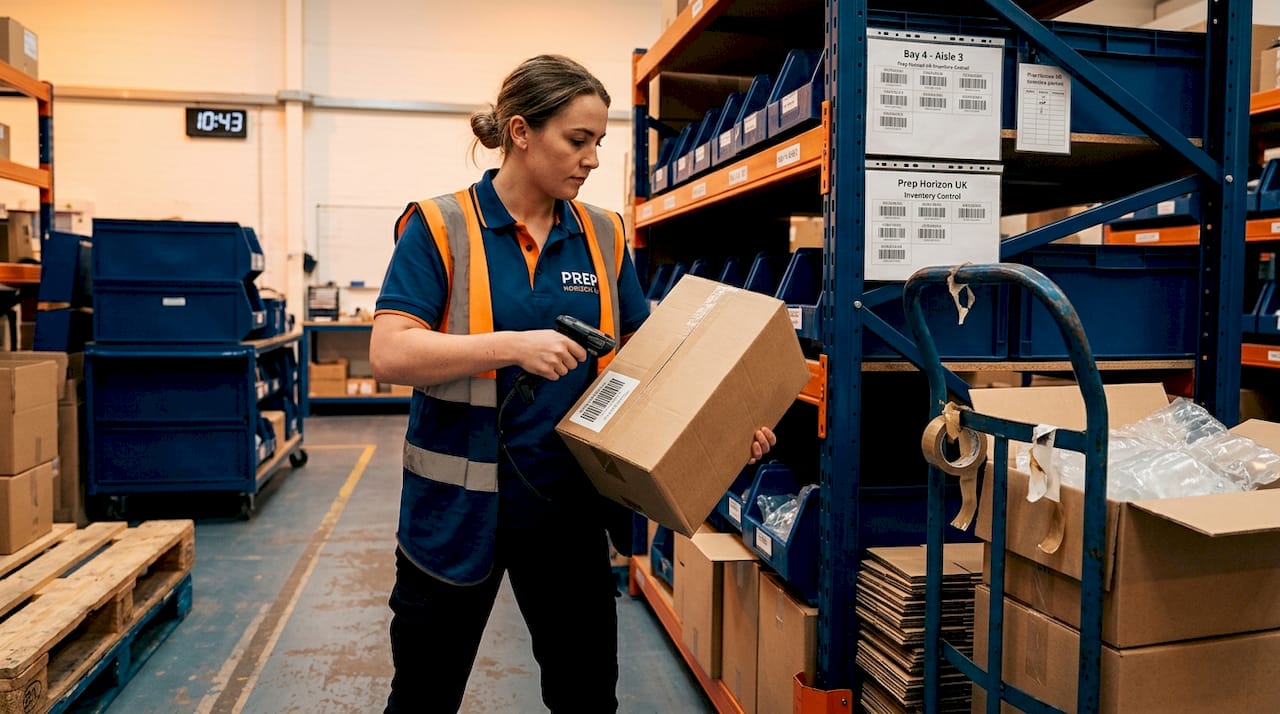
Professional prep centres typically process FBA prep in 2 to 5 business days, which is considerably faster than most sellers manage when doing it themselves at home or in a small office. But that headline figure comes with important caveats.
Providers vary significantly by processing speed, capacity, and communication quality. What affects your actual turnaround?
Queue length at the time of arrival: During peak periods such as Q4 or Prime Day, wait times can double even at well-run centres
Shipment size: A pallet of 1,000 mixed SKUs takes far longer than 200 identical units
Prep complexity: Bundling or kitting adds significant time per unit compared to basic label-and-bag jobs
Receiving delays: If your supplier sends goods with unclear labelling or mixed products, the prep centre must spend time sorting before prep even begins
Pro Tip: Ask your prep centre what their current average turnaround is before you send a shipment, not just what it is during quiet periods. A reliable prep partner will give you an honest current estimate rather than quoting their best-case figure.
Capacity matters too. Some smaller prep centres have minimum and maximum volume thresholds. If you are planning a large product launch or a seasonal push, confirm in advance that your prep centre can absorb the volume without pushing your timeline back significantly.
How to choose the best prep centre for your UK Amazon FBA business
Choosing a prep centre is one of the decisions that genuinely shapes your Amazon business. Make the wrong call and you are dealing with delays, compliance failures, and the frustration of re-doing work you already paid for.
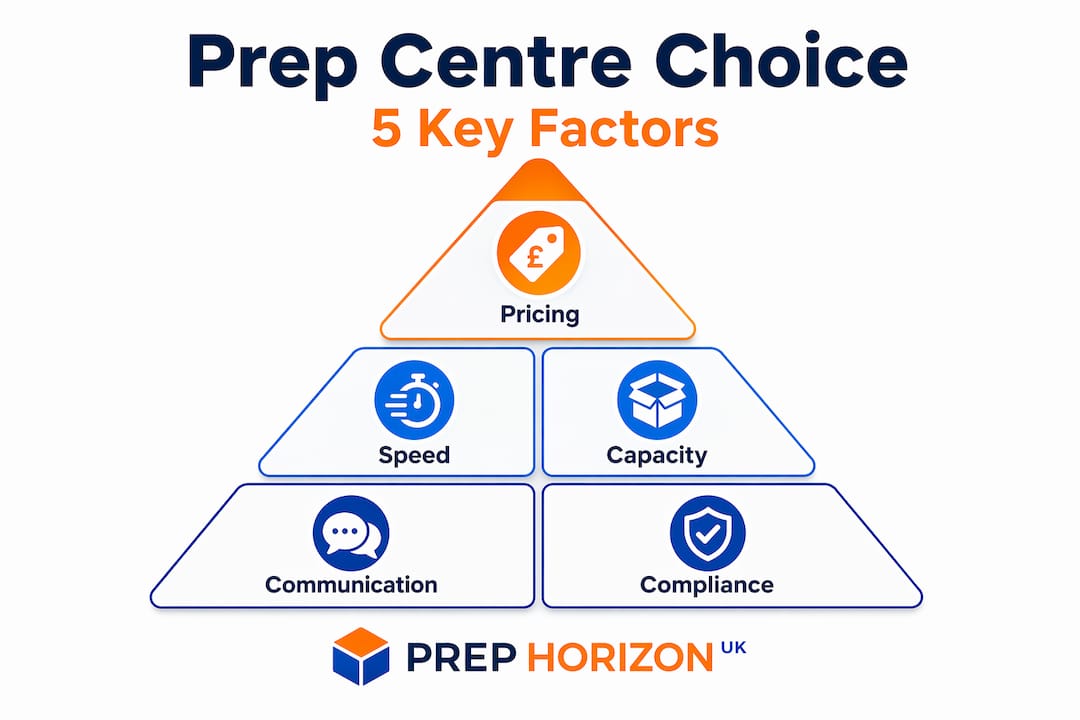
Key deciding factors include pricing model, processing speed, capacity, communication quality, and how well the centre handles your specific SKU types. Here is how to evaluate each one practically:
Evaluation factor | What to look for | Red flags |
Pricing model | Transparent per-unit rates with a clear add-on menu | Vague quotes or hidden minimums |
Compliance knowledge | Familiarity with current Amazon inbound requirements | Uncertainty about FNSKU placement or box label rules |
Location (UK) | Proximity to major UK ports or your supplier’s delivery routes | Locations that add unnecessary transit time |
Communication | Dedicated contact, photo confirmation, clear issue escalation | Slow responses or no photographic proof of work |
Capacity | Ability to scale with your business | Hard volume caps with no warning |
Beyond the table, consider these practical steps when vetting a new prep centre:
Request a trial shipment of 50 to 100 units before committing to larger volumes. Inspect the output yourself.
Ask for photos of completed prep work as a standard part of their service. Good centres already offer this.
Check their familiarity with Amazon’s current prep centre requirements. Requirements update, and a centre that is working from year-old knowledge is a liability.
Compare against a 3PL model: A general third-party logistics provider is not the same as an FBA-specialist prep centre. 3PLs handle storage and distribution broadly; prep centres are built specifically around Amazon’s rules.
Pro Tip: Location within the UK matters more than most sellers realise. A prep centre close to your primary port of entry (Felixstowe, for instance, if you source from Asia) reduces transit costs and the risk of goods being delayed in transit before they even reach prep.
Optimising your prep centre workflow for UK Amazon FBA success
Even with a good prep centre, a disorganised seller creates delays and errors. The relationship between you and your prep centre is genuinely two-sided, and your workflow on the sending side has a direct impact on what comes out the other end.
Better compliance accuracy reduces rejection and penalty fees, improving the return on what you invest in prep. Here is how to set up that workflow properly:
Send your shipping plan details first. Create your Amazon inbound shipment plan before goods arrive at the prep centre. Share the FNSKU barcodes and box configuration details in advance so the team is ready.
Specify packaging materials upfront. If your products need a specific gauge of polybag or a particular type of cushioning, confirm this in writing before the shipment arrives.
Understand the two layers of labelling. Every unit needs an FNSKU label at unit level, and every carton needs Amazon’s box label on the correct sides. These are separate requirements and both must be correct.
Ensure FNSKUs cover existing barcodes. This is one of the most common causes of scanning errors at Amazon’s fulfilment centres. Your prep centre should know this, but verify it is part of their standard labelling process.
Use your prep centre for bundles and kitting. If you sell multipacks or promotional sets, have the prep centre build them rather than asking your supplier. Supplier-built bundles often do not meet Amazon’s specific requirements.
Audit prep quality periodically. Request photos on at least the first few shipments. Then do spot checks regularly, particularly after any staff changes at the centre.
The workflow optimisation principles that experienced FBA sellers use all come back to one idea: clear instructions given early prevent expensive corrections later.
Pro Tip: Build a simple one-page prep brief for each ASIN you sell. Include the FNSKU, required packaging type, any fragile or hazmat notes, and your box configuration. Send it with every inbound shipment. Prep centres work faster and more accurately when they are not guessing.
Why relying on a professional prep centre is a strategic investment, not just a cost
Here is the view most Amazon sellers only reach after making costly mistakes: prep is not an operational expense you tolerate. It is one of the most effective risk management decisions you can make in your FBA business.
The uncomfortable truth is that DIY prep feels cheaper until it is not. When you prep products yourself, you are working with human attention divided across listing research, supplier negotiation, customer service, and a dozen other demands. Compliance accuracy under those conditions sits at roughly 85% for most sellers doing it themselves. Professional prep centres push that accuracy to over 99%. That 14% difference translates directly into fewer rejected shipments, fewer Amazon prep charges, and less frozen capital sitting in limbo.
The hidden costs of DIY prep are also easy to underestimate. Consider the time spent sourcing polybags, printing labels, measuring carton weights, building shipment plans, and physically packing boxes. For many sellers, that is five to ten hours per shipment. Multiply that across a growing catalogue and you are running a packing operation instead of a business.
There is also a scaling argument that is rarely made clearly enough. A prep centre does not grow slowly like a team you hire. You send more units, they prep more units. There is no warehouse lease, no staffing problem, no equipment purchase. The strategic value of outsourcing prep is that it makes your cost base variable precisely when you need it to be.
Account health is the final piece. One consistently non-compliant shipment source is enough to trigger performance warnings from Amazon. A professional prep centre removes that risk almost entirely. You are not just buying a service. You are buying reliability into the part of your business that Amazon scrutinises most.
Get started with trusted UK Amazon FBA prep services today
If this overview has made one thing clear, it is that the quality of your prep operation has a measurable impact on your Amazon account health, your margins, and your ability to scale without operational chaos.

At Prep Horizon UK, we handle receiving, inspection, FNSKU labelling, polybagging, bundling, and full shipment creation for UK Amazon FBA sellers. Our pricing is transparent, our turnaround times are fast, and we communicate clearly at every stage of the process. Whether you are sending 100 units or 10,000, we have the capacity and the compliance knowledge to get your inventory into Amazon’s fulfilment network correctly and quickly. Take a look at our pricing options and see exactly what working with a specialist UK prep centre looks like for your business.
Frequently asked questions
What services does an Amazon prep centre typically handle?
Amazon prep centres manage quality inspection, FNSKU labelling, protective packaging such as polybagging or bubble wrapping, and full shipment preparation to meet Amazon’s size and weight rules. Most also offer bundling, kitting, and returns processing as optional add-ons.
How much does it cost to use a prep centre in the UK?
Base prep fees typically range from £0.40 to £1.50 per unit for standard services, with additional charges for polybagging, bubble wrapping, or complex bundling. Your actual cost depends on product type, volume, and which optional services you need.
How long does the prep process usually take?
Professional prep centres generally complete FBA prep within 2 to 5 business days, though timing varies based on current workload, shipment size, and how complex the prep requirements are for your specific products.
Why should I choose a prep centre instead of prepping products myself?
Compliance accuracy improves from roughly 85% with DIY prep to over 99% with a professional centre, significantly reducing rejected shipments and Amazon penalty charges. It also frees your time to focus on sourcing, marketing, and growing your catalogue.
Recommended
Comments