
Amazon FBA shipping rules explained: UK compliance guide

Getting your products rejected at an Amazon fulfilment centre because of a missing label or an incorrectly placed barcode is a frustrating and costly experience. Many UK sellers assume their shipments are compliant, only to discover that a small oversight has triggered fees, delays, or outright rejection. This guide covers the core Amazon FBA shipping rules you need to follow, from FNSKU labelling and barcode placement to packaging, bundling, and pallet preparation. By the end, you will have a clear picture of what Amazon expects at every stage, so you can ship with confidence and avoid the most common compliance mistakes.
Table of Contents
Key Takeaways
Point | Details |
Label every unit | Every product must have a correct FNSKU label covering any existing barcode. |
Prep bundles properly | Label all sets with ‘Sold as Set – Do Not Separate’ and package them as single units. |
Avoid rejected shipments | Simple compliance checks and routines help avoid delays, extra fees, or outright rejections. |
Leverage pro services | Professional prep centres can streamline the process and ensure FBA rules are always met. |
Understanding core Amazon FBA shipping rules
Amazon’s FBA programme is built on precision. Every unit that enters a fulfilment centre must meet a defined set of requirements before it can be stored, picked, and dispatched to customers. These rules are not arbitrary. They exist because Amazon processes millions of units across its network, and a single mislabelled or poorly packaged item can slow down the entire receiving process.
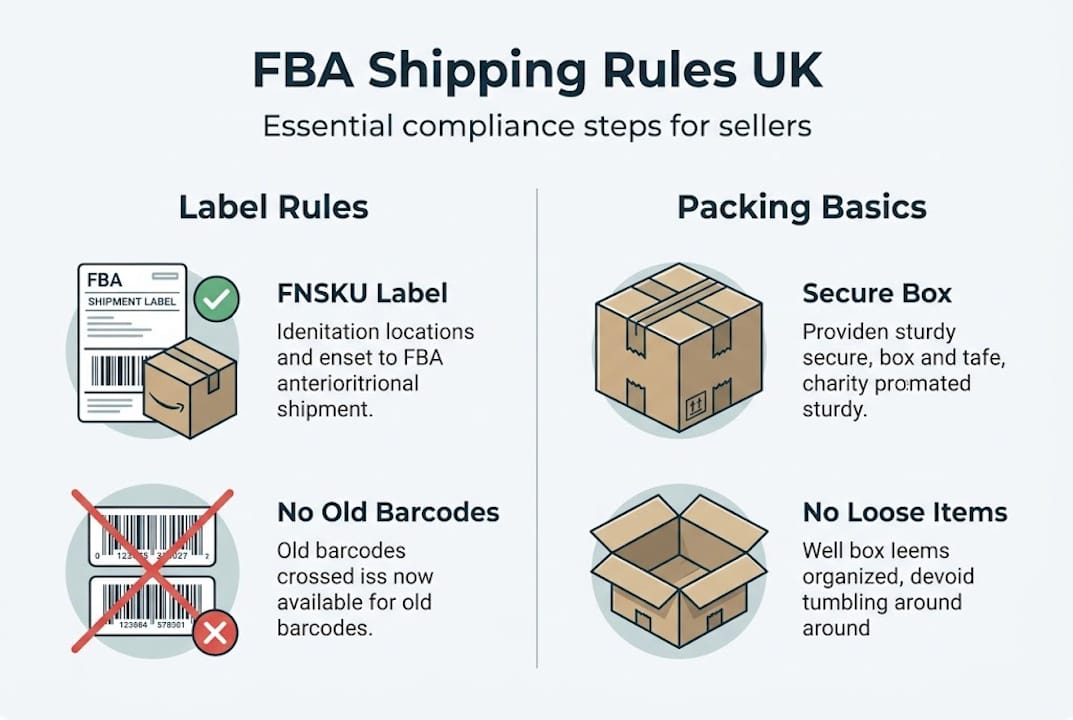
The most fundamental requirement is that every unit must carry an accurate FNSKU (Fulfilment Network Stock Keeping Unit) label. This is Amazon’s own barcode, tied specifically to your ASIN and the condition of the product. Without it, warehouse staff cannot identify what the product is, who it belongs to, or where it should go. As Amazon’s seller guidance confirms, incorrect labelling leads to rejection or additional fees, both of which eat directly into your margins.
Beyond the FNSKU, barcodes must be scannable. This sounds obvious, but in practice it means the label must be flat, unobscured, undamaged, and positioned so a scanner can read it without rotating the item. Labels placed on curved surfaces, over seams, or partially covered by tape are common causes of scanning failures.
Here is a summary checklist of the standard requirements every seller should know before dispatching an FBA shipment:
Every unit must have a scannable FNSKU label
Labels must match the ASIN and condition listed in Seller Central
Existing manufacturer barcodes must be covered where required
Packaging must be secure and appropriate for the product type
Shipment IDs must be accurate and match the contents
Boxes must not exceed weight and dimension limits
Expiry dates must be clearly visible on perishable or dated goods
Understanding these FBA prep requirements from the outset saves you from the kind of surprises that derail shipments and delay your inventory going live. Sellers who treat compliance as a one-time task rather than an ongoing process tend to encounter the same problems repeatedly. Building these checks into your workflow from day one is the most efficient approach.
Product labelling: The FNSKU and barcode essentials
Labelling is where the majority of FBA compliance failures occur. It is also the area where a small investment of time and attention pays the greatest dividends. Let’s break down exactly what is required and how to get it right every time.
The FNSKU is not the same as a manufacturer barcode or an EAN. It is a unique identifier generated by Amazon for your specific listing. When a customer orders your product, Amazon’s system uses the FNSKU to locate the correct unit in the correct condition. Using a manufacturer barcode instead of an FNSKU is one of the most common errors new sellers make, and it can result in your inventory being misidentified or commingled with other sellers’ stock.
Here is a comparison of the two barcode types to clarify when each applies:
Barcode type | What it identifies | When it is required |
FNSKU | Your specific ASIN and condition | Always required for FBA units |
EAN/UPC (manufacturer) | The product globally | Must be covered if FNSKU is used |
ASIN barcode | Amazon’s product identifier | Not a substitute for FNSKU |
As Amazon’s own guidance states, every individual unit must have a scannable FNSKU label matching the ASIN and condition, placed flat and covering any existing barcodes. This is not a suggestion. It is a hard requirement, and failure to comply results in the unit being flagged during receiving.
Follow these steps to label your products correctly:
Generate the FNSKU label from Seller Central under your inventory listing.
Print labels on white, matte label stock at a minimum size of 1 inch by 2 inches.
Ensure the barcode is clear, with no smudging, ink bleed, or distortion.
Apply the label flat on a smooth surface, avoiding curved edges or seams.
Cover any existing manufacturer barcodes completely with the FNSKU label.
Scan each label with a barcode scanner before dispatch to confirm readability.
Many sellers choose to outsource this process to a specialist FNSKU labelling service to save time and reduce the risk of errors. This is particularly useful when dealing with high volumes or products that have awkward packaging.
Understanding the full scope of barcode labelling rules also helps you avoid issues with specific product categories, such as clothing, footwear, and fragile items, which have additional requirements. For a thorough overview of what Amazon checks during receiving, the barcode compliance guide is a useful reference.
Pro Tip: Always print a test label and scan it before printing in bulk. A label that looks correct on screen can still fail to scan if your printer settings are slightly off or the contrast is too low. A quick test run saves hours of relabelling.
Packaging, bundling, and pallet preparation rules
Having mastered individual labelling, attention must then shift to how products are grouped and shipped. Packaging rules vary depending on whether you are sending individual units, multi-item bundles, or full pallets, and each category has its own set of requirements.
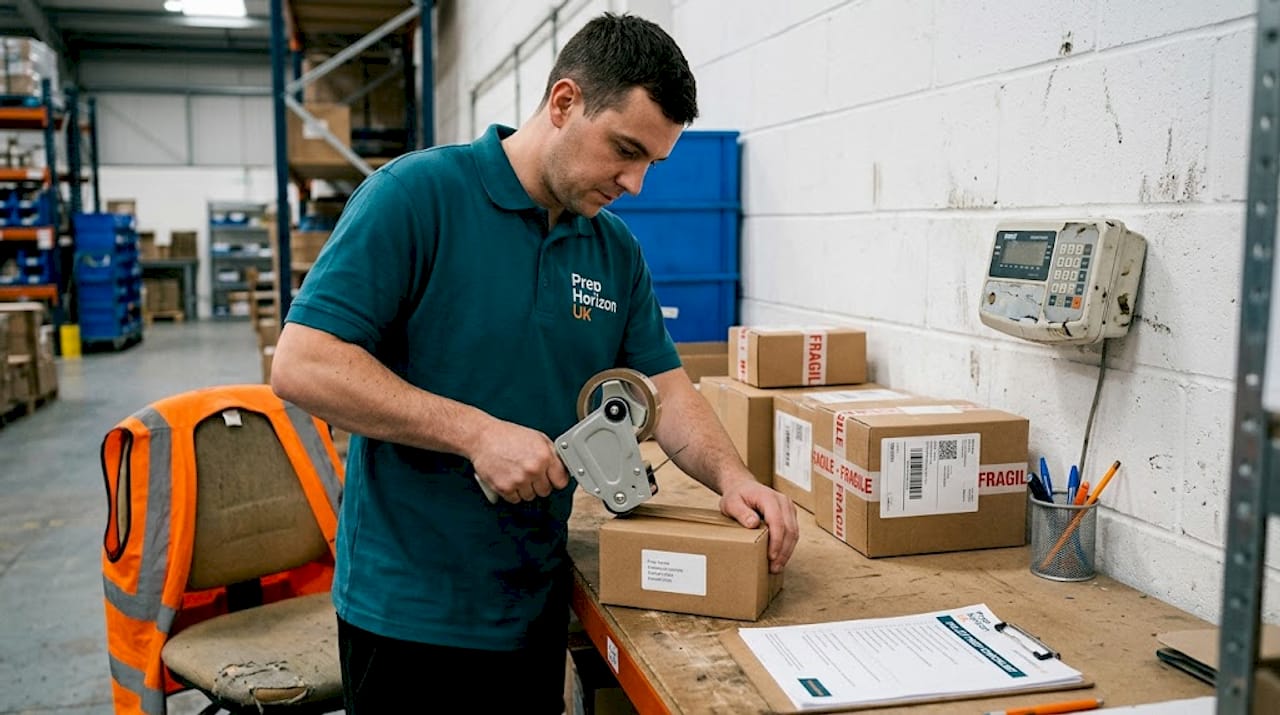
For individual units, packaging must protect the product throughout the fulfilment journey. This means no loose items, no exposed sharp edges, and no packaging that could come apart during transit. Polybags used for soft goods must be transparent, have a suffocation warning printed on them if they are larger than 5 inches on any side, and must be sealed completely. Fragile items must be bubble-wrapped so that a drop test from a height of 1.2 metres does not damage the product.
Bundles and sets introduce additional complexity. A bundle is a group of complementary products sold together as a single unit. Amazon requires that bundles and sets be labelled clearly as “Sold as Set – Do Not Separate” to prevent warehouse staff from splitting the items during processing. Without this label, individual components may be separated and processed independently, which breaks your listing and creates inventory discrepancies.
Here is a comparison of the key rules across the three main shipment types:
Shipment type | Key labelling requirement | Packaging rule | Common mistake |
Individual unit | FNSKU on each unit | Secure, appropriate packaging | Missing FNSKU or uncovered barcode |
Bundle or set | “Sold as Set – Do Not Separate” | All items in one sealed package | Items not secured together |
Pallet | Shipment ID label on all four sides | Stable, shrink-wrapped, no mixed IDs | Mixed shipment IDs on one pallet |
For pallet shipments, the requirements are equally precise. Amazon specifies that pallets must be stable and must not mix different shipment IDs. Each pallet must have shipment ID labels on all four sides, and the pallet itself must be shrink-wrapped to prevent movement during transit. Boxes must be stacked in a column or brick pattern, not a pyramid, to maintain stability.
Key packaging requirements to keep in mind:
Polybags must include a suffocation warning for bags over 5 inches on any side
Fragile items must pass a 1.2-metre drop test when packaged
Bundles must be sealed and labelled as a single unit
Pallets must not exceed 1.8 metres in height including the pallet itself
Heavy items over 30kg require FBA Heavy and Bulky enrolment
For a detailed walkthrough of how to prepare your inventory correctly, the inventory preparation guide covers product-specific scenarios in practical detail. If you regularly ship bundles, a professional bundle prep service can handle the packaging and labelling to Amazon’s exact specifications, reducing the risk of rejection.
Pro Tip: When preparing pallets, photograph each completed pallet before dispatch. If Amazon raises a discrepancy during receiving, photographic evidence of your pallet’s condition and labelling at the point of dispatch is invaluable for resolving disputes quickly.
Final checks and dispatch: Ensuring compliance before shipment
Once your products are packed and ready, a careful pre-shipment check can be the difference between smooth processing and disruptive delays. This stage is often rushed, particularly when sellers are working against tight restocking deadlines. Slowing down for 30 minutes of verification can save days of delays and significant additional costs.
Work through this pre-shipment checklist before every dispatch:
Confirm every unit has a scannable FNSKU label that matches the correct ASIN and condition in Seller Central.
Verify that all manufacturer barcodes are fully covered where required.
Check that all packaging is secure and meets the product-specific requirements for your category.
Ensure bundles are labelled “Sold as Set – Do Not Separate” and sealed as a single unit.
Confirm the shipment ID on your boxes matches what is recorded in Seller Central.
Weigh and measure boxes to confirm they are within Amazon’s box content limits.
For pallets, check stability, shrink-wrap integrity, and that all four sides carry the shipment ID label.
Cross-reference your box contents against the shipment plan to confirm quantities are accurate.
“The most common cause of FBA receiving delays is not damaged goods or incorrect quantities. It is labelling errors that could have been caught with a two-minute check before the box was sealed.”
The most frequent reasons Amazon rejects or flags shipments include mismatched FNSKUs, uncovered manufacturer barcodes, missing expiry dates on dated products, and shipment IDs that do not match the contents. Each of these is entirely preventable with a structured pre-dispatch review.
Keeping your records updated is equally important. If you make changes to a listing, such as updating the condition or creating a new ASIN variation, the FNSKU changes too. Sending units labelled with an old FNSKU is a surprisingly common error that causes real receiving problems.
As Amazon’s guidance confirms, incorrect labelling leads to rejection or fees, and these costs accumulate quickly across a large shipment. Using a structured shipment inspection checklist as part of your standard process is one of the simplest ways to protect your margins and keep your inventory flowing.
Why most FBA shipment problems are fixable – with the right habits
Here is something worth saying plainly: most FBA compliance failures are not knowledge problems. They are process problems. Sellers who encounter repeated rejections usually know the rules. What they lack is a consistent, repeatable system for applying them.
In our experience working with UK sellers across a wide range of categories, the same issues come up again and again. Mislabelled units, mixed shipment IDs, bundles without the correct “Sold as Set” label. These are not complex mistakes. They are the result of rushing, skipping steps, or assuming that because last week’s shipment was fine, this one will be too.
The uncomfortable truth is that Amazon’s requirements do change, sometimes without much notice. A rule that applied last quarter may have been updated. Sellers who rely on memory rather than documented checklists are the ones who get caught out.
The fix is straightforward. Build a checklist, review it before every shipment, and audit your process every few months against the latest FBA preparation insights. Compliance is not a destination. It is a habit. The sellers who consistently avoid rejection fees and delays are not necessarily more knowledgeable. They are simply more systematic.
Streamline compliance with trusted FBA prep partners
Navigating Amazon’s FBA shipping rules is manageable once you understand the requirements, but applying them consistently across every shipment takes time, attention, and reliable processes. For many UK sellers, the most practical solution is working with a specialist prep centre that handles compliance as a matter of routine.

At Prep Horizon, we manage the full prep process for Amazon sellers, from receiving and inspection to FNSKU labelling, bundling, and shipment creation. Our team works to Amazon’s exact specifications on every order, so your inventory arrives at the fulfilment centre ready to be processed without delays or rejection fees. Whether you are sending your first shipment or scaling to hundreds of units per week, our affordable FBA prep services are built to keep your operation running smoothly. Find out how we can support your business at Prep Horizon.
Frequently asked questions
What label must be on every FBA product unit?
Each unit must carry a scannable FNSKU label that matches the ASIN and the condition listed in your Seller Central account. No other barcode is an acceptable substitute.
What happens if you use the wrong label or miss a barcode?
Amazon may reject your shipment entirely or charge additional labelling fees per unit, as incorrect labelling triggers a compliance flag during the receiving process. Both outcomes delay your inventory going live and reduce your profitability.
How are bundles or sets prepared for FBA shipping?
Bundles must be packaged together as a single sealed unit and clearly labelled “Sold as Set – Do Not Separate” to prevent warehouse staff from separating the items during processing.
Are there special rules for heavy or bulky items?
Items over 30kg must be enrolled in FBA Heavy and Bulky, which comes with specific packing, labelling, and handling requirements designed to ensure safe transport and storage.
How should a pallet be prepared for Amazon FBA?
Pallets must be stable, fully shrink-wrapped, and must not mix different shipment IDs on the same pallet, with shipment ID labels applied to all four sides before dispatch.
Recommended
Comments