
How to ship to Amazon warehouse: UK step-by-step guide

Sending inventory to an Amazon fulfilment centre sounds straightforward until your shipment gets rejected, your labels fail a scan, or your boxes arrive overweight and Amazon charges you for the privilege. Many UK sellers lose hundreds of pounds annually to avoidable prep errors, delayed processing, and non-compliant packaging. Whether you are handling everything yourself or considering outsourcing to a professional service, understanding the full process from start to finish is what separates sellers who scale smoothly from those who spend weekends firefighting warehouse problems.
Table of Contents
Key Takeaways
Point | Details |
Follow Amazon’s requirements | Check all box, pallet, and label specifications before you send anything to avoid costly mistakes. |
Prep centres save time | Outsourcing FBA prep is ideal for scaling, keeping you compliant and making your supply chain stress-free. |
Compliance prevents penalties | Missing labels or wrong box sizes can result in rejected or delayed shipments and hefty fees. |
Track shipments closely | Stay on top of the delivery status and resolve issues promptly for smooth Amazon warehouse check-ins. |
Trust expertise over price alone | Choosing reliable, well-reviewed UK prep services usually saves more money and headaches long term than seeking the absolute lowest price. |
What you need to ship to an Amazon warehouse
Before you dive into the shipping process, it is crucial to know exactly what is required up front. Getting the foundations right means fewer surprises later.
At a minimum, you need an active Amazon Seller Central account with FBA enabled, compliant packaging materials (boxes, polybags, bubble wrap, pallet wrap), FNSKU labels for every unit, and an account with an approved carrier such as UPS or DPD. That might sound like a short list, but each item carries detailed sub-requirements that catch sellers off guard.
Here is a quick overview of the core physical and account requirements:
Requirement | What you need |
Account | Seller Central with FBA activated |
Boxes | Rigid, six-sided, no oversize per Amazon rules |
Labels | FNSKU per unit, box content labels per carton |
Pallets | 1200x1000mm wooden, max 1.8m height, shrink-wrapped |
Carrier | UPS, DPD, or another Amazon-approved carrier |
Software | Seller Central shipping plan tool |
The key rules to keep in mind before you pack a single unit:
Standard boxes must not exceed 63.5cm on any single side and must weigh no more than 23kg
Each unit requires an FNSKU label that completely covers the manufacturer’s barcode
You must never mix different SKUs or different product sizes within the same box
Pallets must be standard UK size (1200x1000mm), shrink-wrapped, and labelled on all four sides
Heavy packages exceeding 15kg require a “Team Lift” label visible on every side
As detailed guidance on FBA prep requirements makes clear, ignoring any of these rules can result in refused deliveries, unexpected fees, or suspended inbound shipments.
This is precisely where many growing sellers turn to a professional FBA prep centre. As FBA Mogul explains, prep centres receive supplier shipments directly, inspect every unit, apply FNSKU labels, polybag or bubble wrap items as needed, bundle products, repack into compliant cartons or pallets, and create and send shipping plans to Amazon fulfilment centres. For scaling sellers, this removes an enormous operational burden. If you want to understand the full range of seller services for FBA, it is worth reviewing what each service type actually covers before making a decision.
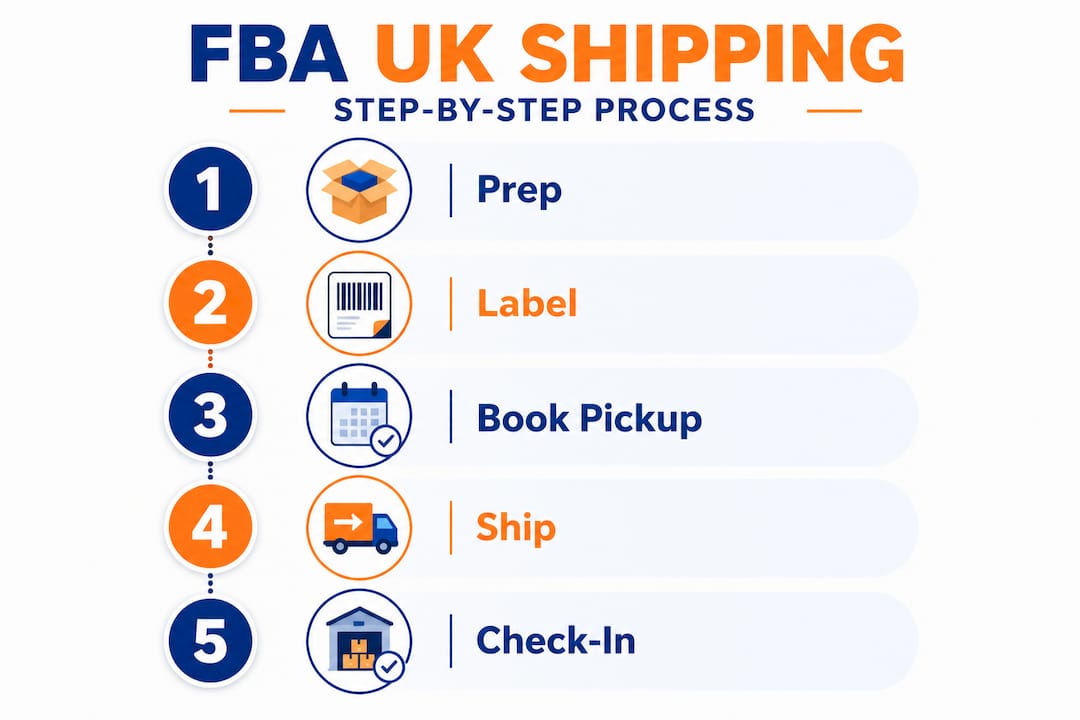
Step-by-step shipping process for Amazon FBA UK
With the essentials secured, you are ready to execute each step of the shipping process. Following this sequence precisely is what keeps your shipments compliant and your inventory moving quickly into Amazon’s fulfilment network.
Create a shipping plan in Seller Central. Log into Seller Central, navigate to “Send to Amazon,” and add the ASINs you want to ship. Confirm quantities, product condition, and who will apply labels (you or Amazon).
Apply FNSKU labels to every unit. Print labels from Seller Central and affix them so they fully cover the original manufacturer barcode. Do not leave gaps or allow the original barcode to show through.
Pack units into compliant boxes. Fill boxes appropriately, avoiding overloading. Confirm dimensions and weight meet Amazon’s limits, then seal with strong tape along all seams.
Enter box content information in Seller Central. For each carton, enter the exact contents (ASIN, quantity). Amazon uses this data to match your shipment at the warehouse.
Select your delivery method. Choose Small Parcel Delivery (SPD) for individual boxes or Less than Truckload (LTL) for palletised shipments. For pallets, you will also need to book a haulier.
Choose your carrier. As Amazon UK seller forums confirm, carriers such as UPS and DPD are standard choices for delivering to Amazon fulfilment centres. Compare rates and book through your carrier account or a freight broker.
Print and apply shipping labels and FBA box labels. Seller Central generates both. Apply them clearly to the outside of each carton. For pallets, place labels on all four sides.
Dispatch and confirm shipment in Seller Central. Once goods are collected or dropped off, mark the shipment as dispatched and enter tracking details. Amazon will begin monitoring for arrival.
Here is a side-by-side look at what changes when you use a prep centre versus going it alone:
Task | Self-prep | Prep centre handles |
Receiving supplier delivery | You arrange at own address | Prep centre receives directly |
Inspection and quality check | Manual, your responsibility | Done on arrival |
FNSKU labelling | You print and apply | Applied per Amazon spec |
Polybag/bubble wrap | You source and apply | Included as required |
Box packing and content entry | You pack and enter in Seller Central | Handled in full |
Shipping plan creation | You build in Seller Central | Created and submitted for you |
Carrier booking | You arrange | Often arranged or guided |
Good guidance on prepping inventory will give you a detailed breakdown of physical prep standards if you are going the DIY route.

Pro Tip: Always double-check the Amazon-assigned fulfilment centre address and every shipping label detail before dispatch. Amazon regularly splits shipments across multiple warehouses, and sending boxes to the wrong address causes delays that can take weeks to resolve.
Understanding inbound compliance is equally important. Amazon’s policies are updated regularly, and a rule that applied last quarter may have changed.
Avoiding common mistakes and compliance risks
Even with a sound step-by-step process, common mistakes can easily cost you time and money. Amazon’s requirements are strict, and the warehouse team will not make exceptions for “nearly compliant” shipments.
The most frequent errors UK sellers make include:
Overweight or oversized boxes. Exceeding 23kg or 63.5cm on any side leads to automatic rejection at the dock.
Missing or inaccurate FNSKU labels. A label that is peeling, placed at an angle, or does not fully cover the barcode will cause a scan failure.
Mixed SKUs in one box. Placing two different product types in the same carton unless Amazon has specifically approved it creates sorting errors at the warehouse.
Incorrect box content information. If your Seller Central entry says 24 units but the box contains 22, Amazon will flag the discrepancy.
Pallets without proper labels. Each pallet face must carry a label. Missing even one face can hold up the entire delivery.
No “Team Lift” labels on heavy packages. Any package over 15kg must display this label on every side, not just the top.
Amazon’s core UK FBA shipping requirements: Standard boxes have a maximum of 63.5cm per side and 23kg in weight. Heavy boxes can go up to 30kg but require appropriate labelling. UK pallets must be the standard 1200x1000mm wooden format, standing no taller than 1.8m, weighing no more than 1,000kg, fully shrink-wrapped with no overhangs, and labelled on all four sides. Each unit must carry an FNSKU label covering the manufacturer barcode. Hazmat and standard products must be kept separate, and sizes must not be mixed within cartons. These UK FBA requirements are non-negotiable.
The practical impact of getting this wrong is significant. Amazon issues Inbound Performance notifications for repeated violations, and if your account accumulates enough problems, your ability to create new shipments can be restricted. Detailed guidance on UK FBA shipping rules covers each rule in the depth needed to stay fully compliant.
Pro Tip: Build a physical checklist that runs through every box and pallet before your carrier collects. Better still, have a UK FBA prep centre validate your shipment against Amazon’s current requirements before it leaves your premises. This single habit prevents the majority of compliance-related rejections.
What to expect once your shipment arrives
Once you have shipped, it is important to know how goods are processed and what feedback to expect. Many sellers assume once boxes leave their door the job is done, but the receiving process at Amazon’s warehouse requires your attention too.
When your shipment arrives at an Amazon fulfilment centre, the warehouse team will:
Check carton and pallet integrity. Any boxes that are crushed, wet, or visibly damaged may be refused or flagged for investigation before being accepted into the system.
Scan box content labels. Amazon matches physical contents against your Seller Central shipping plan. Discrepancies are noted as inbound exceptions.
Verify FNSKU labels on units. Items that cannot be scanned are set aside, and you will receive a notification in Seller Central detailing the problem.
Record receipt and update inventory. Once verified, units are added to your FBA inventory, making them available for sale.
Flag and report any issues. If Amazon finds missing items, damaged stock, or labelling errors, you will see these flagged in the “Shipment Summary” within Seller Central.
Most shipments to UK Amazon warehouses are checked in within two to five business days of arrival, though peak periods such as Q4 and Prime Day preparation windows can stretch this to ten days or more. It is worth building this buffer into your restock planning so you do not run out of stock while waiting for inventory to go live.
If you encounter problems, your first port of call is the Seller Central “Help” section and the Inbound Performance tab. For persistent issues, opening a case through Seller Central support with your shipment ID and tracking number is the fastest route to resolution.
This is where quality prep pays dividends. As FBA Mogul notes, prep centres that specialise in creating and sending compliant shipping plans to Amazon fulfilment centres are ideal for scaling sellers who need both compliance and speed. When every box arrives correctly labelled, correctly packed, and matched to an accurate shipping plan, Amazon’s receiving process moves faster and problems are far less common. If you are weighing your options, a review of resources on choosing a prep centre will help you identify what quality preparation actually looks like in practice.
A smarter approach to Amazon FBA shipping: Our view
Beyond the steps and specs, making the right choices can genuinely transform your FBA experience. Here is something most articles will not tell you directly: the biggest risk in outsourcing your FBA prep is not a rogue prep centre, it is a cheap one.
We see it regularly. Sellers compare prep centre prices, pick the lowest per-unit rate, and then lose far more money in Amazon chargebacks, shipment rejections, and restocking delays than they ever saved. A prep centre charging 10p less per unit that misapplies 5% of your FNSKU labels will cost you more in a single shipment than months of paying a fair rate elsewhere.
The question to ask is not “who is cheapest?” but “who can I rely on?” Reliability shows up in specific ways: response times under 24 hours, clear communication about receiving and processing, and transparent tracking of your inventory through every stage. A high Trustpilot rating and Amazon Service Provider Network (SPN) status are two concrete signals that a prep centre operates to a documented, auditable standard. Neither is a guarantee, but both reflect a level of accountability that protects you when things go wrong.
We also think the prep centre vs in-house warehousing debate is often framed incorrectly. Sellers treat it as a cost question when it is really a capacity and risk question. In-house prep makes sense when you have consistent volume, trained staff, and the space to process correctly. For most small to mid-sized UK sellers, the better question is how to find cost-saving ideas that do not compromise quality. The answer is usually a prep centre with straightforward pricing, not the cheapest option available.
Reputation, communication, and consistent standards matter far more than the price per label.
Streamline your FBA shipping with trusted UK prep partners
Ready to put these steps into practice? Knowing the process is one thing. Executing it consistently, at volume, without errors, is another challenge entirely.

At Prep Horizon UK, we handle the full receiving, inspection, labelling, bundling, and shipment creation process so you can focus on sourcing and selling. Our team works to Amazon’s current standards, communicates clearly at every stage, and turns shipments around quickly. Whether you are sending ten units or ten pallets, we give you the confidence that your inventory arrives ready to go live. Explore our affordable UK prep services to find a pricing plan that fits your volume, or visit our trusted FBA prep centre homepage to learn how we support UK Amazon sellers every day.
Frequently asked questions
Do I need a prep centre to ship to Amazon warehouse in the UK?
No, you can process shipments yourself, but using a prep centre saves significant time and reduces the risk of compliance errors that lead to delays or fees. As FBA Mogul explains, prep centres receive, inspect, label, and send compliant shipments directly to Amazon fulfilment centres on your behalf.
How are shipping mistakes penalised by Amazon?
Amazon may reject, delay, or return non-compliant shipments and can charge additional fees for labelling or sorting errors. Repeated violations noted in your Inbound Performance dashboard can also restrict your ability to create future shipments, as outlined in Amazon’s UK requirements.
Which couriers are approved for Amazon FBA shipments in the UK?
Approved carriers include UPS and DPD for both small parcel and pallet deliveries to Amazon fulfilment centres, as confirmed in Amazon Seller Forums guidance on how to ship to FBA warehouses in the UK.
What label must be on each product for FBA?
Each product unit must carry an FNSKU label that fully covers the original manufacturer barcode, as required by Amazon’s packaging rules for UK FBA shipments.
How fast are UK Amazon warehouses to receive and process shipments?
Most shipments are checked in within two to five business days of arrival, though peak trading periods such as Q4 or Prime Day can extend this to ten days or more. Planning your restock schedule around these windows helps avoid stockouts while inventory is being processed.
Recommended
Comments